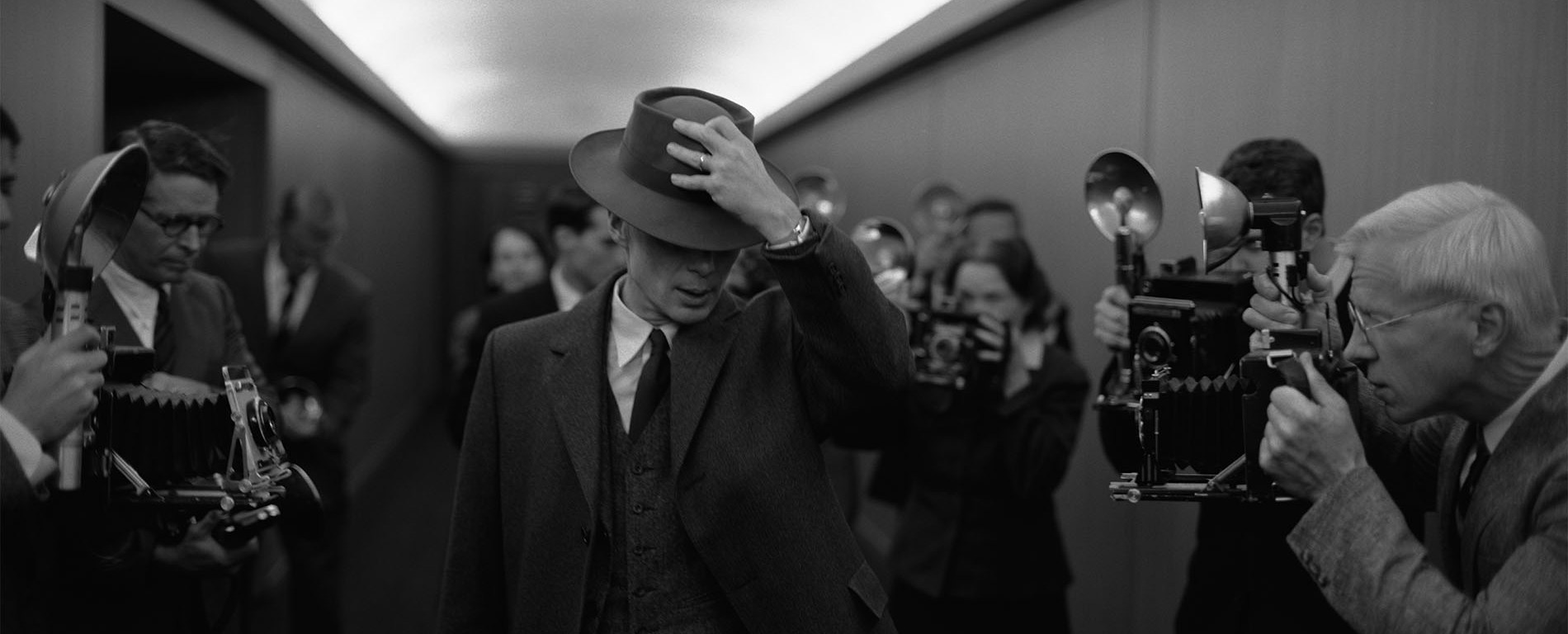
Long before Little Boy and Fat Man were dropped on Hiroshima and Nagasaki in 1945, even before he first glimpsed his creation two weeks earlier at Trinity, J. Robert Oppenheimer was haunted by the bomb. Played by Cillian Murphy and written for the screen and directed by Christopher Nolan, Oppenheimer opens with the theoretical physicist as a young student disturbed and haunted by abstract images of fire, destruction, and particles—a chaotic world existing just behind our own. It’s the reality hidden by the truth we choose to see, he tells his future wife, Kitty (Emily Blunt). She is stuck in a loveless marriage. He’s involved in a one-sided affair. Neither wants to admit the truth behind the veneer they present.
One of Oppenheimer’s more effective aspects is the myriad ways that idea plays out. When U.S. Col. Leslie Groves (Matt Damon) comes to Oppenheimer to recruit him to manage the Manhattan Project, he comes with information that the Nazis are building the atomic bomb and must be stopped at all costs. By the time Oppenheimer delivers his bomb, Germany is in shambles, so the president drops it on Japan. Flashback to those prewar days, and Oppenheimer is a vocal opponent of fascism in Europe, primarily Franco in Spain. So he aligns himself, albeit briefly and somewhat tangentially, with the communist party. But by the time the war is over, fascism is no longer the threat—communism is. So it goes. Oppenheimer thought he was building a bomb to end the war, but all he did was start another one. And where Oppenheimer thought his enemies lay in wait in the armed services, he could not see the U.S. Atomic Energy Committee chairman, Lewis Strauss (Robert Downey Jr.), coming for him.
A master of compressing and collapsing time, Nolan presents these periods—1939-45, 1954, and 1959—as one swiftly moving river of narrative, cutting back and forth without markers or titles, favoring tension above all else. It’s spectacularly successful, and one of the tricks Nolan pulls off is to make a three-hour story feel like a sprint instead of a marathon.
A large part of that is thanks to the performances. Particularly Murphy’s depiction of Oppenheimer from a zealous young man who is so brilliant he can learn languages, lecture on quantum mechanics, publish papers, jet set from institution to institution while still finding time for illicit affairs, to the meticulously crafted image of the modern-day scientist complete with pork pie hat and pipe, to a man who—if not atoning for his part in the creation of atomic weapons—then at least grappling with the consequences he could not foresee and the one theoretical possibility he maybe shouldn’t have ignored.
Oppenheimer is loaded with dozens upon dozens of players, with practically every speaking role played by a recognizable actor. It mostly works, but it also telegraphs too much. You know David Hill is going to play a larger role than the narrative wants to reveal simply because it’s Academy Award winner Rami Malek in the part. Oppenheimer is a big movie, but not big enough to serve them all, and one of the movie’s foibles is that some, particularly Jean Tatlock (Florence Pugh), feel more like window dressing than integral parts.
Was it wrong to build the bomb? One of the numbers tossed out in the movie estimates the two bombs dropped on Japan resulted in 200,000 deaths. Does that number offset the number of U.S. and Japanese soldiers that would have died in a ground invasion? History seems to think so. But history also thinks the creation of the bomb was a Pandora’s box with no hope found at the bottom. From our vantage point in 2023, hope might take the position that what was unleashed on Hiroshima and Nagasaki was so terrifying that it has not been used on an enemy target since—despite the fact that the world collectively holds enough nuclear weapons to destroy every last living life form, including bacteria, many times over.
But Pandora is not the Greek myth Oppenheimer is going for. Instead, Nolan pulls on the threads of Prometheus—which authors Kai Bird and Martin Sherwin use for their book American Prometheus, the basis of Nolan’s movie—the god who brought fire to man and was tortured for the rest of eternity for it. Oppenheimer, the man who fathered unheralded destruction the world had not yet seen, can relate. But we do not chain our gods to rocks and command eagles to eat their livers. Instead, we put ours on the cover of Time, reward them with military contracts, applaud them on speaking tours, and quietly dismantle their entire life in backrooms and kangaroo courts. And then, after enough time has passed, we make movies about them.

Oppenheimer (2023)
Written and directed by Christopher Nolan
Based on the book American Prometheus: The Triumph and Tragedy of J. Robert Oppenheimer by Kai Bird and Martin Sherwin
Produced by Christopher Nolan, Charles Roven, Emma Thomas
Starring: Cillian Murphy, Emily Blunt, Robert Downey Jr., Alden Ehrenreich, Jason Clarke, Josh Hartnett, Florence Pugh, Matt Damon, Benny Safdie, Rami Malek, David Krumholtz
Universal Pictures, Rated R, Running time 180 minutes, Opened July 21, 2023

Discover more from Michael J. Cinema
Subscribe to get the latest posts sent to your email.
 Michael J. Cinema
One thought on “OPPENHEIMER”
Comments are closed.