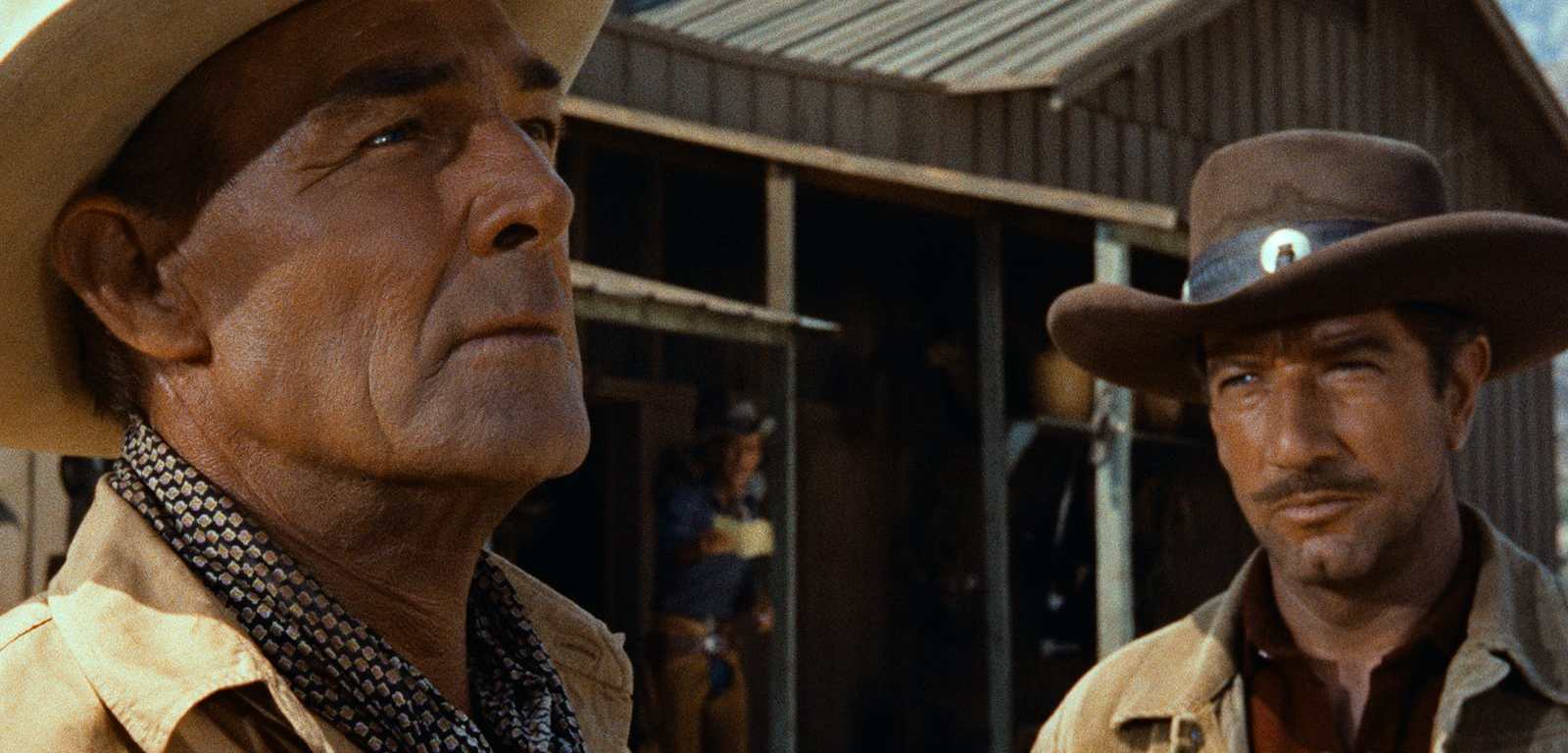
Patrick Brennan is an amiable fellow: Tall with a disarming face that looks a little like tanned leather. You wouldn’t call him the intimidating type, but one look says he can handle himself in a fight. He used to ramrod for Mr. Tenvoorde of the Tall T Ranch, but now he’s looking to start his own. Gonna have stock? Frank Usher asks. Sure, Brennan replies. Gonna work the earth? Frank asks, losing himself to the fantasy. “I intend to,” Brennan says through gritted teeth.
If that exchange sounds curt, it’s because Frank has a gun and Brennan doesn’t. Frank (Richard Boone in the role that landed him the lead on Have Gun — Will Travel) is the leader of two ruthless killers: the childish Billy Jack (Skip Homeier) and another who answers to the racist epithet Chink (Henry Silva). The three held up the swing station outside of Contention to wait for the stagecoach to come. But they didn’t figure on the stage showing up an hour early. This one is a special charter courtesy of Willard Mims (John Hubbard), his rich wife Doretta (Maureen O’Sullivan), driver Frank Rintoon (Arthur Hunnicutt), and Brennan (Randolph Scott). Rintoon picked up Brennan—much to Willard’s chagrin—after Brennan lost his horse in a bet to Mr. Tenvoorde (Robert Burton). Now, they’re all stuck at the station, disarmed, and under the uneasy watch of two psychopaths and Frank.
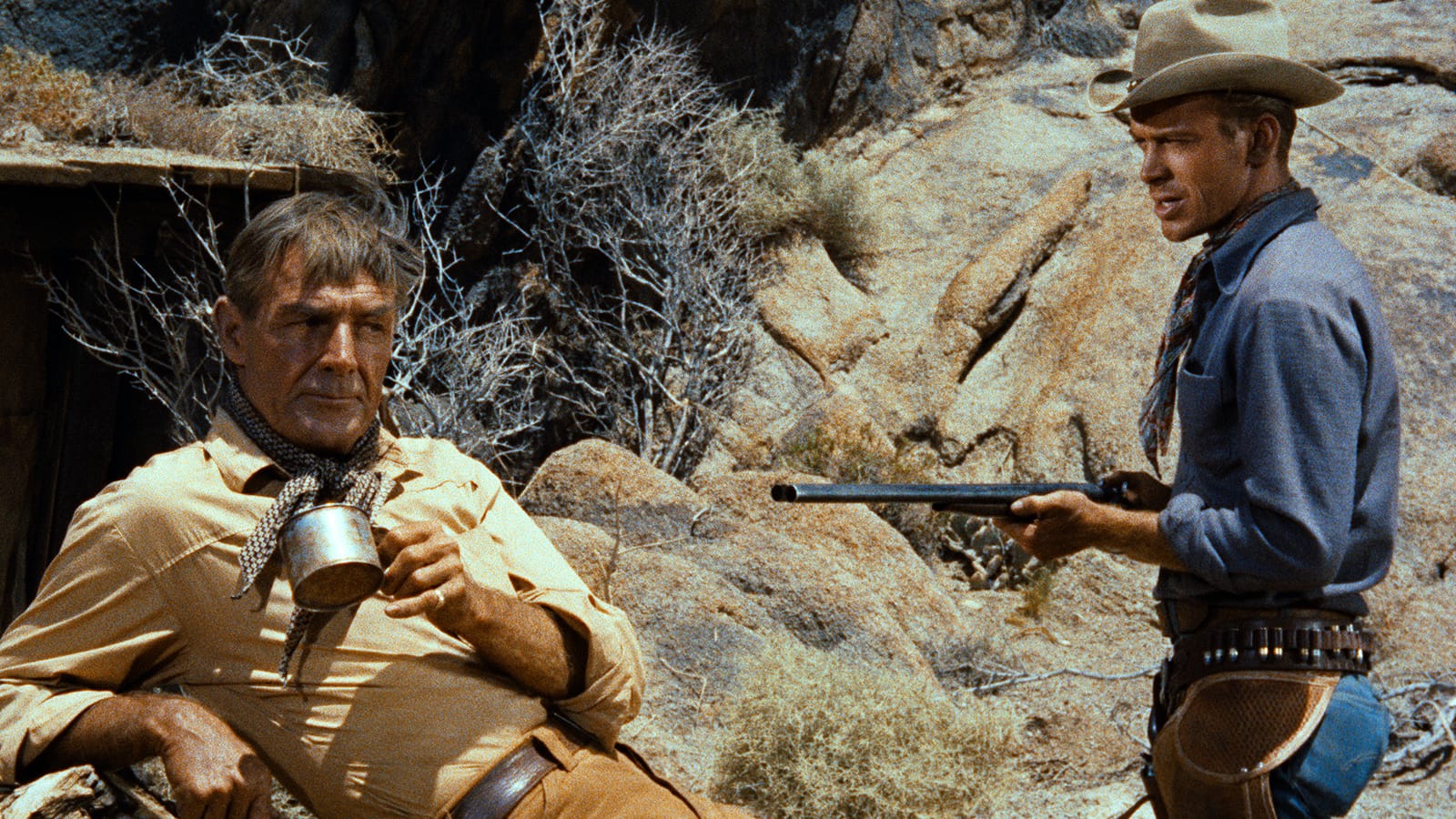
Based on Elmore Leonard’s 1955 short story The Captives, The Tall T is the second pairing of actor Scott and director Budd Boetticher and the first under Scott and producer Henry Joe Brown’s production company for Columbia Pictures. From 1957 through 1960, Scott, Brown, and Boetticher made five films: The Tall T, Decision at Sundown, Buchanan Rides Alone, Ride Lonesome, and Comanche Station, a series of tough, spare, and exhilarating westerns with each one coming in at under 80 minutes. In the annals of the western genre, this series, commonly known as the Ranown Cycle, is top of the crop.
Screenwriter Burt Kennedy expanded Leonard’s original story, mostly through a prologue introducing the relationship between Brennan, the station manager Hank (Fred Sherman), and his young son, Jeff (Christopher Olsen). Jeff idolizes Brennan and his untethered ways. Hank does, too, and hopes his hard work tending the station pays off so Jeff doesn’t have to suffer the same fate he has. Sadly, both end up on the wrong side of Frank’s gang. Kennedy and Boetticher, and Leonard before them, dispatch with this nasty business off-screen, adding significantly more menace to the trio because both the audience and Brennan have to construct the events in the mind rather than the eye.
Leonard, a master when it comes to terse storytelling—“he held the shotgun calmly as if doing this was not something new”—lends Kennedy and Boetticher a blueprint for future Ranown scripts, even if he wasn’t, reportedly, pleased with the page to screen translation. Yet, it is the hold up at the swing station, 12 minutes of tension equal to some of the best standoffs Sergio Leone could muster, where Kennedy sticks so close to Leonard’s original it’s practically word for word.
It’s this type of scene, with Scott’s cowboy playing the stoic center—heroic without having to be so—that Kennedy and Boetticher would return to again and again. Ditto for the governing structure of the films: Scott would ride in from nowhere, find a problem, solve it, and ride out again. It’s a formula that didn’t need reinvention, just variations.

Part of that was due to Scott’s presence: humble but never out of his element, even when outmanned. He can and does take care of himself but with neither the swagger nor confidence of a John Wayne or Clint Eastwood. He feels more real that way, less constructed. Wayne famously said he never acted, only reacted. Scott takes that aphorism to its logical conclusion. His Brennan is constantly reacting. From being offered a seed bull for free if he can ride it to walking 15 miles under the unforgiving sun because he lost his horse in a bet. From trying not to get shot by Frank’s men to trying to find a way to get Doretta to safety. And when he does, he doesn’t dwell on it too long. “Come on,” he says as he gets her up on her feet, “It’s going to be a nice day.”
That makes the Ranown Cycle sound more rote than they feel. By keeping the movies brisk and the story tight, Boetticher employs an economy of storytelling that is enviable in today’s landscape of bloated runtimes and overly busy storylines. Camera moves are held to a minimum, mostly tracking and panning shots following actors and long shots highlighting the harsh and rugged landscape of his frequent location, California’s Alabama Hills. The performances are equally spare, the characters speaking in simple, almost clipped dialogue. When Brennan inquires about the fate of Hank, Chink replies, “He’s over there in the well.” Scott’s face, which barely changes, registers that he knows exactly what that means. “And the boy?” Brennan asks. “He’s in there with him,” Chink replies.
And therein lies another aspect of what makes the Ranown Cycle special: the villains. Silva’s Chink is so chilling he practically steals the show. Boone’s Frank is so likable you almost root for him. Homeier’s Billy Jack’s arrested development is so perfectly calibrated I would eagerly watch another movie exploring his life up until this point. Scott’s Brennan is the heart of The Tall T, but the antagonists are the soul.
Kennedy, Boetticher, and Scott had a sixth sense for this and found ways to ensure the villains were never reduced to Bad Guy A and Bad Guy B, cheap fodder for Scott’s cowboy to exert his masculinity. It brought shades of vulnerability and regret to Scott’s protagonists and is one of the many reasons why these movies still work almost 70 years later.
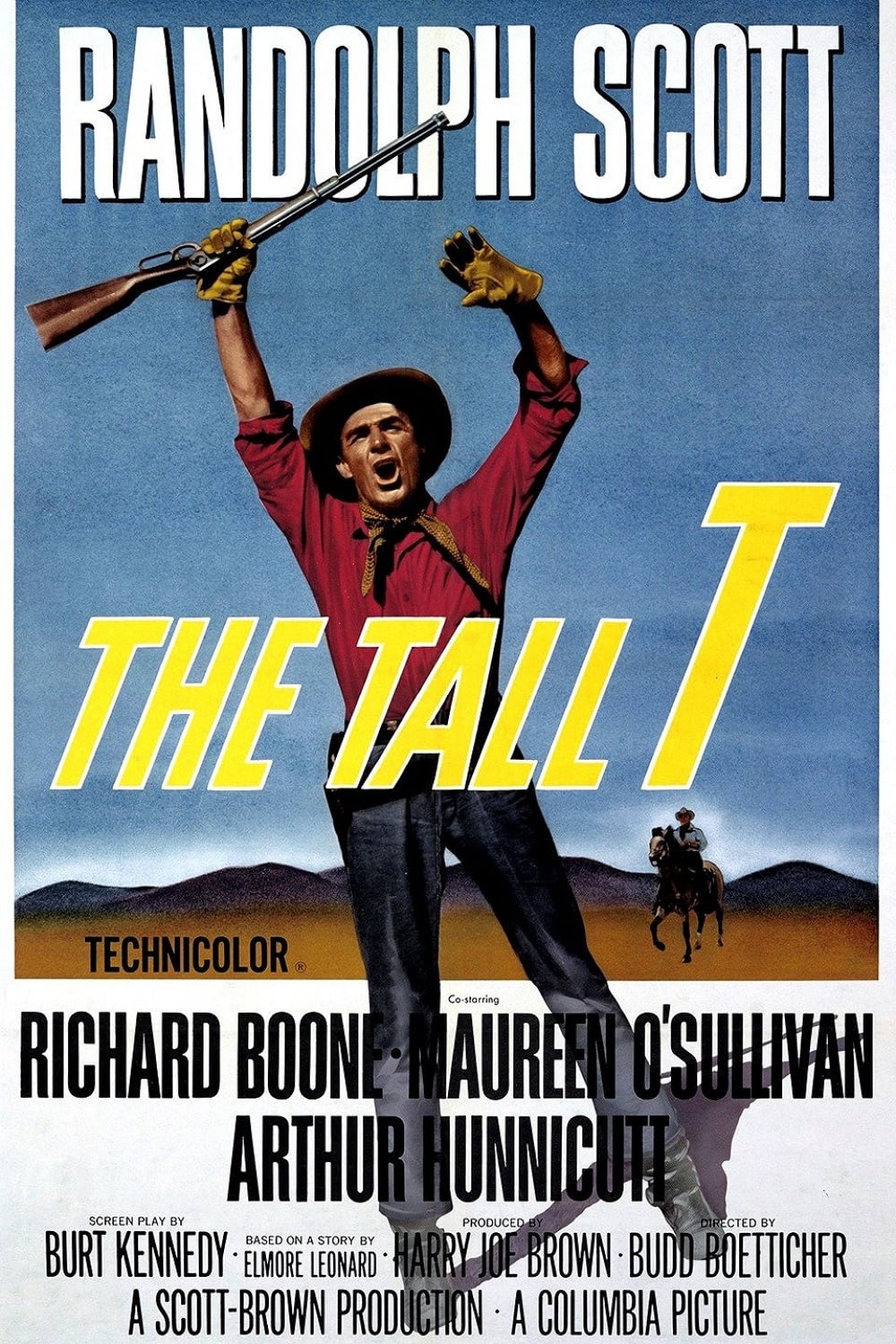
The Tall T (1957)
Directed by Budd Boetticher
Screenplay by Burt Kennedy
Based on the story, The Captives, by Elmore Leonard
Produced by Harry Joe Brown
Starring: Randolph Scott, Richard Boone, Maureen O’Sullivan, Arthur Hunnicutt, Skip Homeier, Henry Silva, John Hubbard, Robert Burton, Fred Sherman, Christopher Olsen
Columbia Pictures, Not rated, Running time 78 minutes, Opened March 25, 1957

Discover more from Michael J. Cinema
Subscribe to get the latest posts sent to your email.
 Michael J. Cinema
One thought on “THE TALL T”
Comments are closed.