
A man can cross over anytime he has the mind.
It ain’t that easy. It ain’t that easy at all.
Likable and sympathetic villains are one of the hallmarks of the Ranown Cycle, a series of westerns made on the cheap for Columbia Pictures with Budd Boetticher in the director’s chair, Harry Joe Brown in the producer’s, and Randolph Scott as the star. Five were made, each as tough and lean and economical as the next. Three of the five bear the name Burt Kennedy as scribe. Of those three, Comanche Station is unique.
Though Comanche Station is only the second production to bear the name Ranown—a portmanteau of Randolph Scott and Harry Joe Brown’s names—this would also be the last time Scott and Boetticher teamed. So it makes sense that Comanche Station brings it all home by playing on tropes from the previous films, taking them to their logical conclusions. Four years later, Sergio Leone would usher in the spaghetti western and effectively kickstart the revisionist western movement that gained steam in the 1960s and ’70s, petered out in the ’80s and ’90s, and occasionally rises from the grave every now and then.
But before that, Kennedy, Scott, Boetticher, and Brown close the cycle with Comanche Station. The story concerns Jefferson Cody (Scott), a bounty hunter who spends his days trading goods and guns with the Natives for captured white women. Cody’s wife was taken by the Comanche 10 years ago, so it’s not so much the bounty he’s after—which is substantial—but the undying hope that he might find her or rescue enough others to quell the guilt deep inside.

The woman Cody trades for, Nancy Lowe (Nancy Gates, sporting a haircut similar to the one Natalie Wood wore in The Searchers), fetches $5,000, which is enough for Ben Lane (Claude Akins), Frank (Skip Homeier), and Dobie (Richard Rust) to start their lives proper. But even three outlaws don’t stand a chance against Cody, so they bide their time.
It’s in this biding that Kennedy’s script develops the outlaws, specifically Frank and Dobie, two uneducated men on the wrong side of the law who don’t know any better. “He never knew anything but the wild side,” Dobie says of Frank. He says it with such resignation, such emptiness it cuts both Cody and the audience. “It wasn’t his fault, though.”
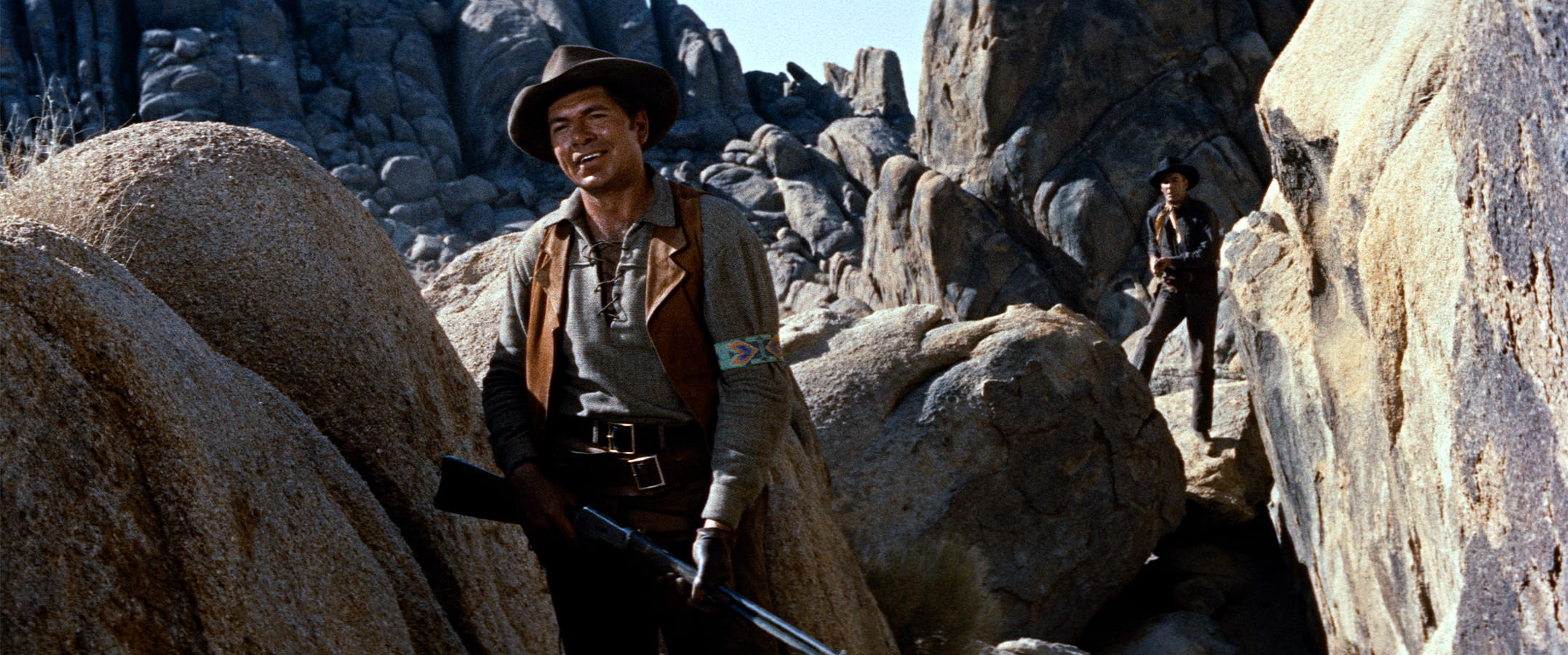
Role-playing runs through the Kennedy-scripted Ranown westerns. The idea that we all have a part to play and no amount of kickin’ and fussin’ against it will do anything. Watch in the showdown in The Tall T, how Richard Boone’s character rides free, but, at the last second, doubles back toward Scott, Henry rifle drawn, like fate pulling two cords together. Or how Lee Van Cleef and Scott practically scold each other in Ride Lonesome: “Don’t make me shoot you!” It’s the same thing here. Scott plays the hero, and Akins, Homeier, and Rust play the villains. “Come too far to turn back now,” Lane says to Cody. Cody has the drop on Lane, and if Lane turns and tries to fire on Cody, Cody will surely cut him down. Both men know it. Everyone in the audience knows it. But Lane must turn, he has no choice, and Cody and everyone watching knows that too. It’s easy to like the villains in a Ranown western. But in Comanche Station, you don’t just like them; you feel sorry for them.
The Ranown westerns are like Greek moralities played out in lonely landscapes populated by the round rocks of California’s Alabama Hills. A whole lot of empty, as Lane calls it, but a stage unlike any other.
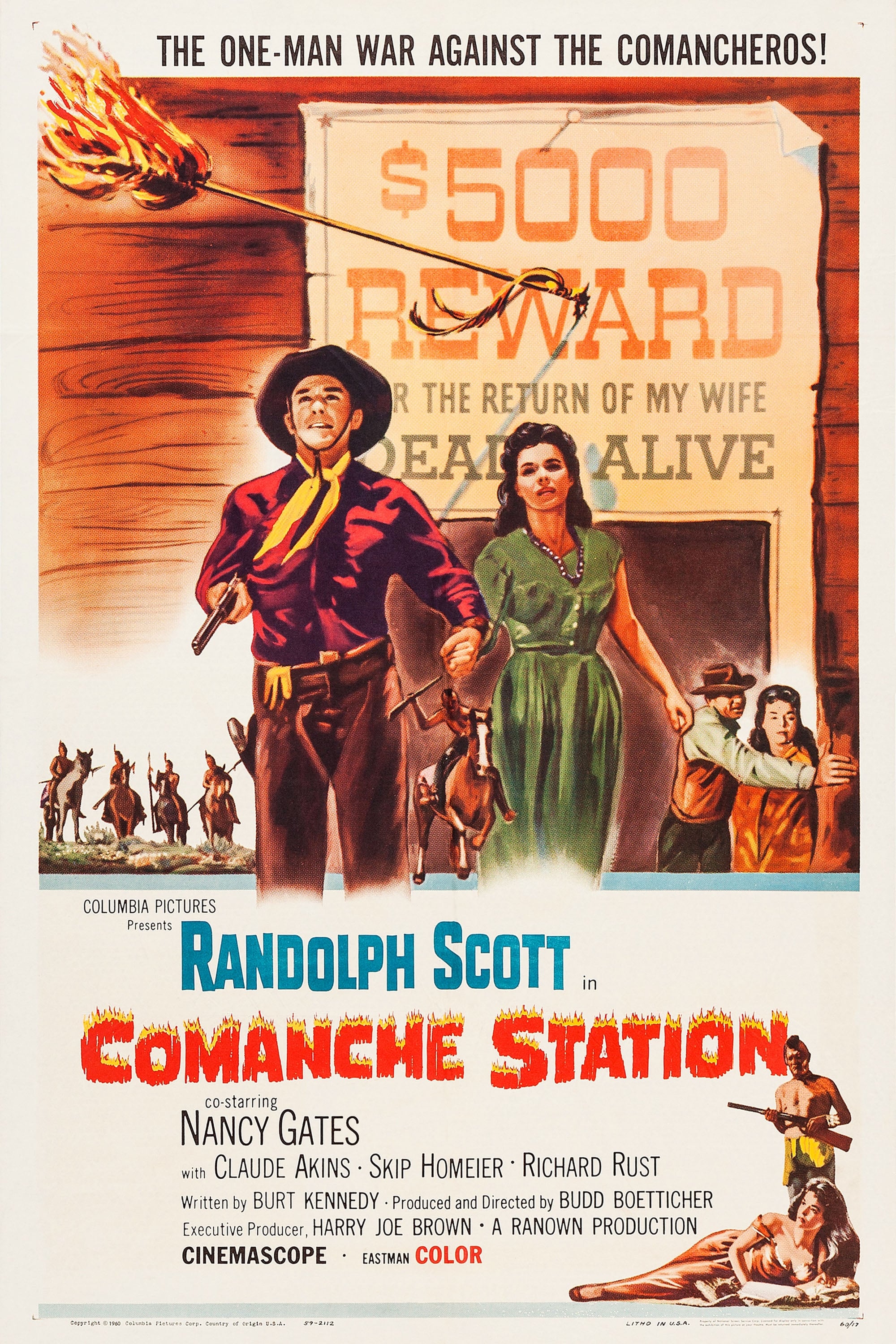
Comanche Station (1960)
Produced and directed by Budd Boetticher
Written by Burt Kennedy
Starring: Randolph Scott, Nancy Gates, Claude Akins, Skip Homeier, Richard Rust, Rand Brooks, Dyke Johnson
Columbia Pictures, Not rated, Running time 73 minutes, Opened Feb. 16, 1960

Discover more from Michael J. Cinema
Subscribe to get the latest posts sent to your email.
 Michael J. Cinema
You must be logged in to post a comment.