
As the story goes, writer/producer/director extraordinaire Francis Ford Coppola started working on Megalopolis in the early 1980s.
Back then, Coppola was coming off one hell of a decade. The Godfather, The Conversation, The Godfather: Part II, Apocalypse Now… He was a titan. He found his friends work in the business, started his own studio, and changed how art—any art—is conceived, developed, and delivered. This period of Coppola’s life, documented in Sam Wasson’s 2023 book, The Path to Paradise: A Francis Ford Coppola Story, paints the picture of a genius, maddeningly unfocused, frustratingly paternal, and possibly one of the worst micromanagers ever to exist. Everything was an innovation. American Zoetrope was his baby, a place where every voice was heard and every idea entertained, but Coppola was to be responsible for it all. He was a benevolent patriarch, sure, but a patriarch nevertheless. There’s an old barb, often thrown at Orson Welles—another larger-than-life filmmaker who couldn’t be contained by the cinematic arts—“There but for the grace of god goes god.” Well, Coppola could have given even Welles a run for his money.
All of that is on display in Megalopolis, Coppola’s long-gestated, self-financed, massive thesis statement about the past, present, and future of humanity. It’s an allegory—or “A Fable” according to the marketing—where modern-day New York City is New Rome and Mayor Cicero (Giancarlo Esposito), banker Hamilton Crassus III (Jon Voight), and genius master builder Cesar Catilina (Adam Driver) vie for the future of the city.
Megalopolis is a mess. Beyond the three-core characters exist dozens more, each one playing several against the others. It’s hard to keep track of who’s zooming who, but that might be part of the intent. The state of America is messy and unfocused, so it makes sense that Megalopolis reflects that confusion—though the messiness in Megalopolis feels less like a realistic depiction of the world we inhabit and more like the unfocused aims of the filmmaker.
For those reasons, I won’t bother with the nitty gritty of Megalopolis’ plot. I doubt my recollections would make sense. Every frame of this movie is so packed with actors, costuming, set dressing, and computer graphics that it’s easy to feel overwhelmed and drift. At one point, I found myself staring at my shoes and discovered that my laces were wrong.

And all those actors, visual layers, and metaphorical meanings are ambitious as hell. They’re also as shallow as a puddle two days after the rain. Cesar’s grand proclamation is that we need to have a conversation about the future, and everyone is invited. But does Coppola show everyone talking about the future together? He does not. Instead, he shows us Cesar and the wild and twisty structures his Megalon element can create. How Megalon works is beyond me. It can build a city. It can also make a see-through dress.
Megalopolis clearly means a lot to Coppola, which makes it all the more frustrating not to like it. He certainly wants you to know that the sandbox he’s playing in is big, and all the great minds that came before have also scratched their names in the dirt. Rousseau, Petrarch, and Marcus Aurelius—all get name-checked. Aurelius takes the cake: he gets quoted three times in a row. Then, there’s the scene where Cesar recites Hamlet’s soliloquy. The other characters in the scene give no indication that they are familiar with the speech. Are we to believe that Cesar is originating “to be or not to be” for the audience within the movie? Why would they know the words of Marcus Aurelius and not William Shakespeare?
That might be an unfair jab. I know we’re in speculative fiction territory here, and maybe New Rome is really old Rome, and the Elizabethan period never happened, so, of course, no one would recognize a line from Shakespeare. It’s not the only time the ground rules aren’t set—how is Cesar stopping time? Megalopolis is more confusion than excitement.
I might need to see Megalopolis again to work things out, but I probably won’t. A couple of years from now, an image from the movie will flicker from my brain in some bizarre fugue state, and I’ll wonder if I’m actually remembering the movie I saw or hallucinating it. It’s that kind of movie.
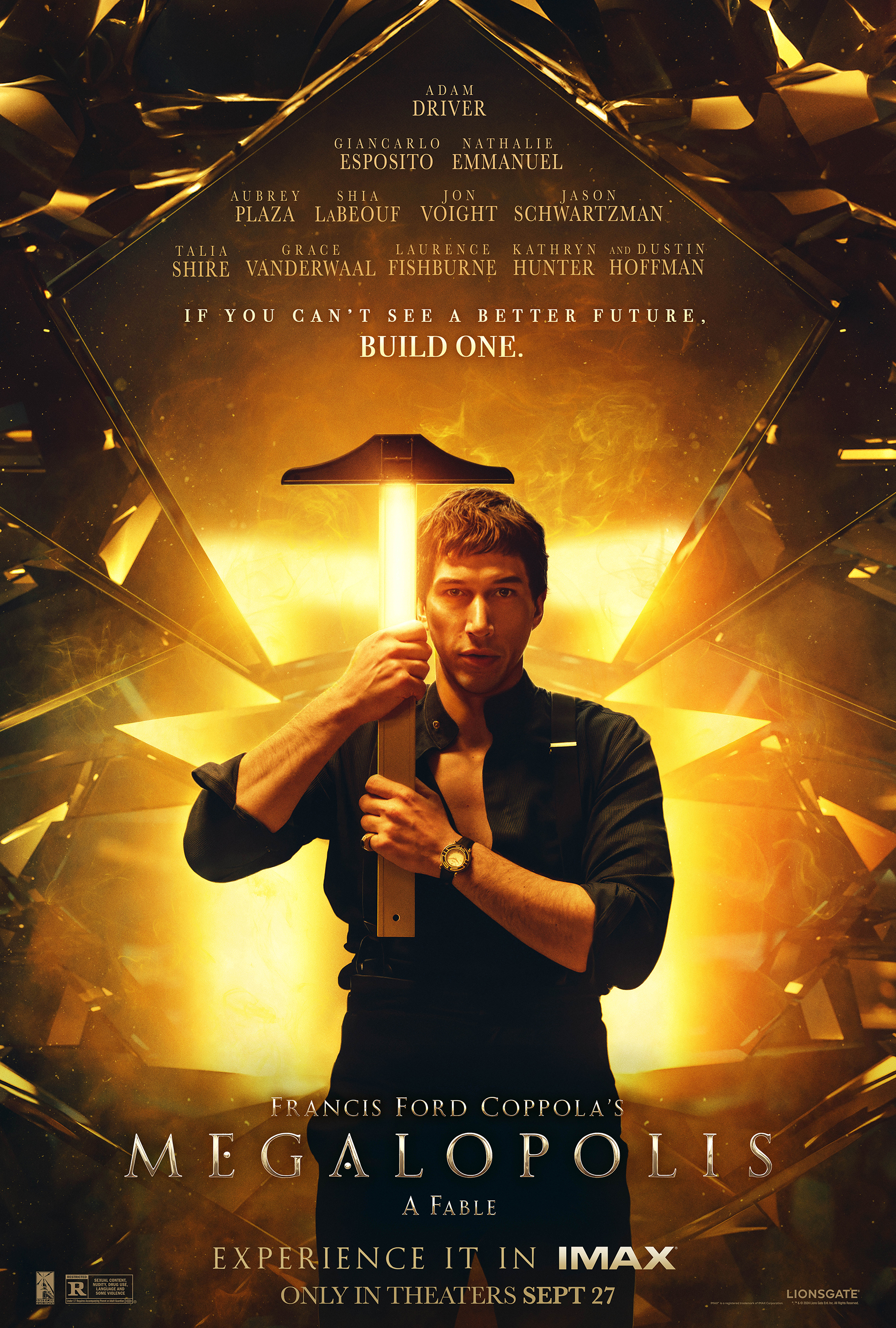
Megalopolis (2024)
Written and directed by Francis Ford Coppola
Produced by Michael Bederman, Francis Ford Coppola, Barry J. Hirsch, Fred Roos
Starring: Adam Driver, Giancarlo Esposito, Jon Voight, Nathalie Emmanuel, Aubrey Plaza, Shia LaBeouf, Laurence Fishburne
Lionsgate, Rated R, Running time 138 minutes, Premiered May 16, 2024 at the Cannes Film Festival.

Discover more from Michael J. Cinema
Subscribe to get the latest posts sent to your email.
 Michael J. Cinema
One thought on “MEGALOPOLIS”
Comments are closed.