
Once upon a time, American letters were full of subversives, satirists, and provocateurs. They made you laugh. They made you think. They changed how you saw the world. The best of them made you uncomfortable within safe spaces and made you feel safe no matter how uncomfortable things got. They helped you grow a thick skin while marveling at beauty in every form.
Terry Southern was such a writer.
Born in Texas in 1924, Southern would become a versatile essayist, novelist and screenwriter. His books, Candy (co-written with Mason Hoffenberg), Blue Movie, and The Magic Christian, are coveted by those in the know. But it’s the movies that made him a legend: Barbarella (1968), Easy Rider (1969), and the painfully funny, eternally prescient Dr. Strangelove or: How I Learned to Stop Worrying and Love the Bomb(1964).
“The humor is always humane,” Nile Southern says, quoting writer Lewis Lapham’s assessment of his father’s work. “It’s not a takedown, and it’s not cruel.”
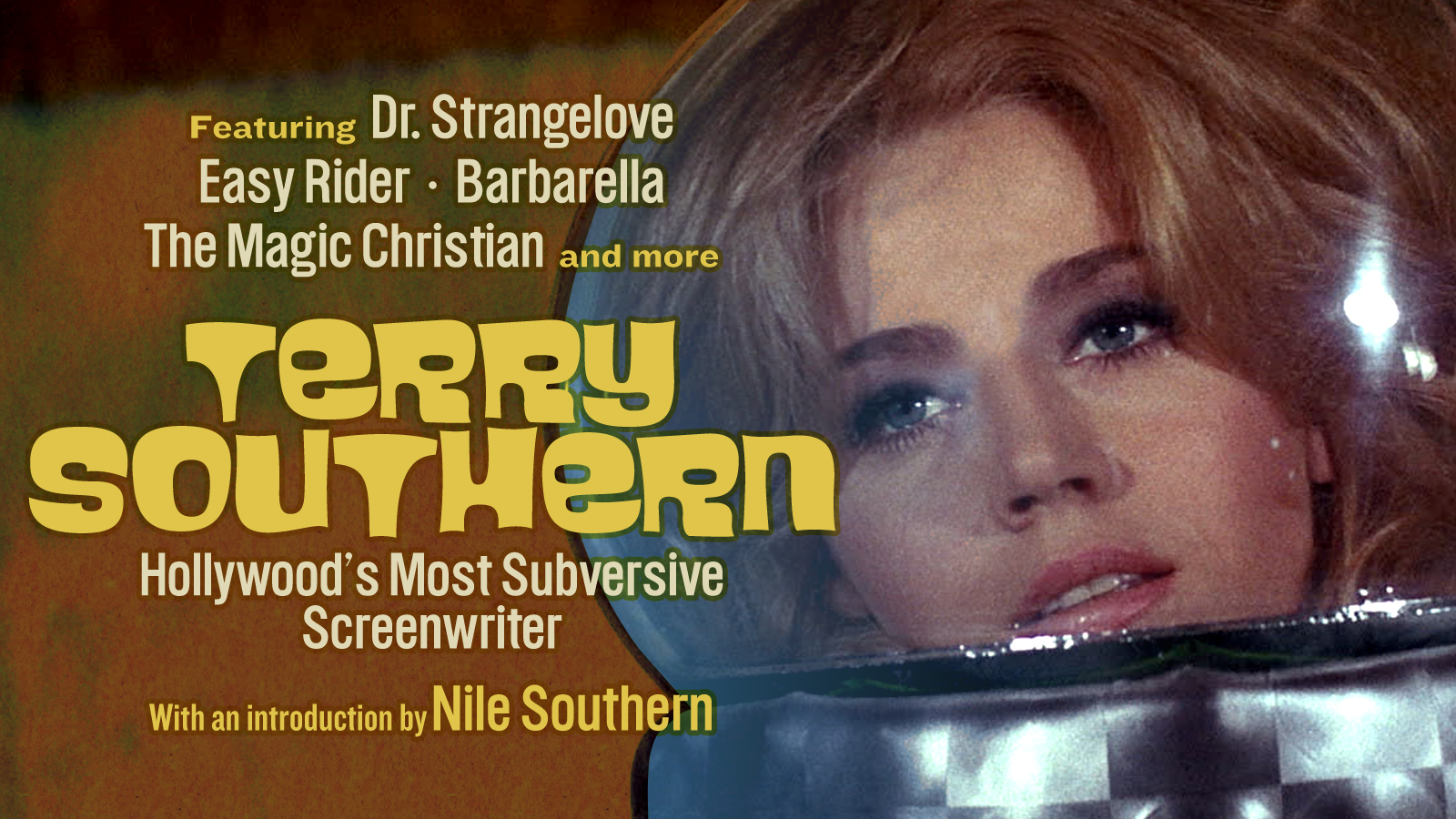
Stationed in Boulder since the early 1990s, Nile is a writer, filmmaker, and “the perennial booster of all things my father.” That’s on full display in his 14-minute introduction for The Criterion Channel’s collection, Terry Southern: Hollywood’s Most Subversive Screenwriter.

Along with Nile’s spotlight, Criterion’s program includes the above plus End of the Road (1970) and The Magic Christian (1969). Despite Southern’s different levels of involvement with each project—and the difficulties trying to retain credit and royalties after they became hits—his singular voice always sings. For Nile, that’s evident in the monologues peppering each.
“You’ll also find [that] in my father’s novels. There will be page after page after page, and it’s one continuous utterance from a character, and it’s often done for effect,” Nile says. “[It’s] up to individual viewers to decode those.”
Decoding won’t take you long in Dr. Strangelove and The Magic Christian, because they’re so funny and absurd you’ll find yourself rewinding just to make sure you caught them the first time. They’re also astoundingly contemporary.
So are the ones in End of the Road—a lesser-known movie Nile hopes more people discover thanks to Criterion’s spotlight—but those bite a little harder. They’re still relevant after all these years, but time has done nothing to blunt their force.
“The culture had reached an apex by the time they were shooting in 1968 when End of the Road began production,” Nile recounts. “Bobby Kennedy had just been shot, and it really influenced the tone of that film—and the kind of existential extremities portrayed in it.”
Critical of the Vietnam War and violence in general, End of the Road stars Stacy Keach and James Earl Jones at the beginning of their film careers. Each is probing the absolute boundaries of their abilities. Nile says it’s “like watching a tennis match.”
“End of the Road, for Terry, was supposed to be the beginning of many films he would produce,” Nile explains. “I think he saw himself throughout the 1970s doing more films like that, that were really pushing the boundaries of what was formally—and content-wise—politically and socially acceptable. But he did not have the opportunity to make more films after that.”
Why Southern didn’t is one of the questions Nile hopes to answer with his documentary about his father, one he’s been “nursing along for decades.” In addition to interviews with Pablo Ferro, Norman Jewison, Gore Vidal, and others, Nile connects Southern’s postwar expat period, the influence of mid-century jazz, The Paris Review, and The Beatles. (Southern was immortalized on the Sgt. Pepper’s Lonely Hearts Club Band album. He’s nestled between Dylan Thomas and Dion DiMucci in the second row, fifth from the left.)
“There’s great depth in Terry’s story that covers a lot of cultural signposts,” Nile says.
Nile has been using the working title Dad Strangelove for the doc, but he’s considering changing it to Beauty in Every Form. That line comes from Southern’s script for 1965’s The Loved One and “harkens back to the French surrealists,” Nile says. It’s about “making the grotesque funny or palatable in some way. Or astonishing.”
Criterion’s spotlight runs throughout June. If luck has a say, it will forge a whole new generation of Southern fans and spur interest in Nile’s documentary. He hopes to finish it in the coming year.
The above interview first appeared in the page of Boulder Weekly Vol. 32, No. 43, “Dad Strangelove.”
Discover more from Michael J. Cinema
Subscribe to get the latest posts sent to your email.
 Michael J. Cinema
You must be logged in to post a comment.