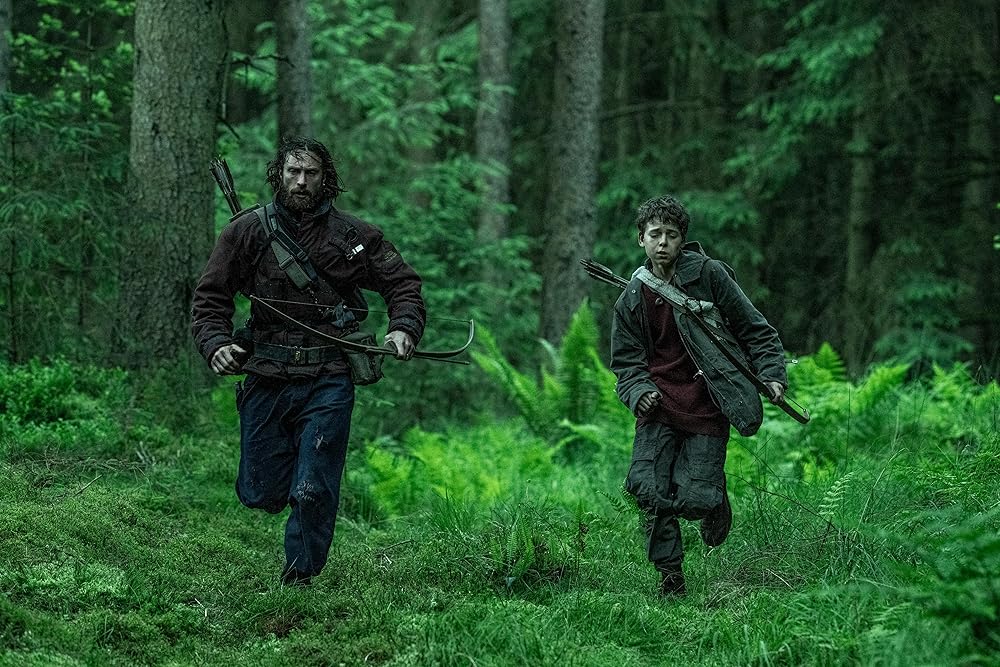
How does one live in a world after it ends? I’m not talking about hoarding provisions and the nuts and bolts of kill-or-be-killed survival, but the impulse to live when everything around you dies.
For the characters of 28 Years Later, their world ended when the rage virus infected the British Isles and transformed civilized human beings into frenzied monsters hell-bent on one thing: consumption. Those free of infection band together into small medieval communities, everyone serves a purpose, and traditional institutions carry on.
But a lot is missing. There is no electricity to power screens or speakers, not a lot of books to read, and no one’s putting out a newspaper. No sports to cheer for, no new restaurants to try. When father Jamie (Aaron Taylor-Johnson) cooks bacon and eggs for his son, he does so with no radio on in the background, no TV to keep him company. When son Spike (Alfie Williams) grills fish out in the wilderness, there is nothing for him to do but stare at his supper roasting over an open flame. It appears there’s going to be a lot less stimulants in the postapocalypse.
Granted, 28 Years Later is the third movie in a reportedly five-installment franchise, so writer Alex Garland and director Danny Boyle aren’t constrained by setting up this world and getting back out in a tidy two hours.
Garland’s script opens in 2002 at the outbreak of the rage virus, then skips ahead to 2031 with the British Isles quarantined from the world. What few survivors remain band together into medieval communities. In one, Spike’s mother (Jodie Comer) is ill and needs outside medical attention. Spike’s father refuses to take her beyond the compound, so Spike smuggles her out and goes on an odyssey to find the last doctor in the land: Kelson (Ralph Fiennes).
Though Garland’s screenplay lacks narrative propulsion, 28 Years Later, like many genre movies, leaves space for the faithful to suss out the metaphors behind the monster. Take your pick: isolation, pandemic, virus, religion, Brexit (maybe), etc. Zombies are blank slates that they can stand in for anything.
Garland and Boyle offer many options, but I suspect they’re interested in what Dr. Kelson has to say. He’s the steadfast pole around which all of Garland’s disparate ideas spin, and Fiennes gives a beautiful and still performance that grounds Boyle’s frenetic tone.
Narratively, Kelson is a death doula with a massive totem to the dead—the only art left in this world. He’s the lone survivor who’s used science to protect himself from the virus. Everyone else employs violence. And Kelson’s the only one with reverence for something beyond himself. That’s the one thing he wants to impart on Spike. It’s probably the one big thing Garland and Boyle hope the audience walks away with.
The Kelson scene is also a visual break from 28 Years’ anemic images and jagged editing. Cinematographer Anthony Dod Mantle uses small digital cameras—including an iPhone 15 Pro Max—to provide immediacy, and Boyle and editor Jon Harris rarely let those shots run longer than three or four seconds. These tactics place us in the characters’ predicament. If death can come from anywhere, we must look everywhere. And look fast, because death is faster.
But when Spike finds Dr. Kelson’s memento mori, 28 Years Later finds a space for the characters and audience to reflect on what it means to die, to sleep no more. That’s the moment 28 Years Later lingers long enough to figure out why we’re here in the first place.
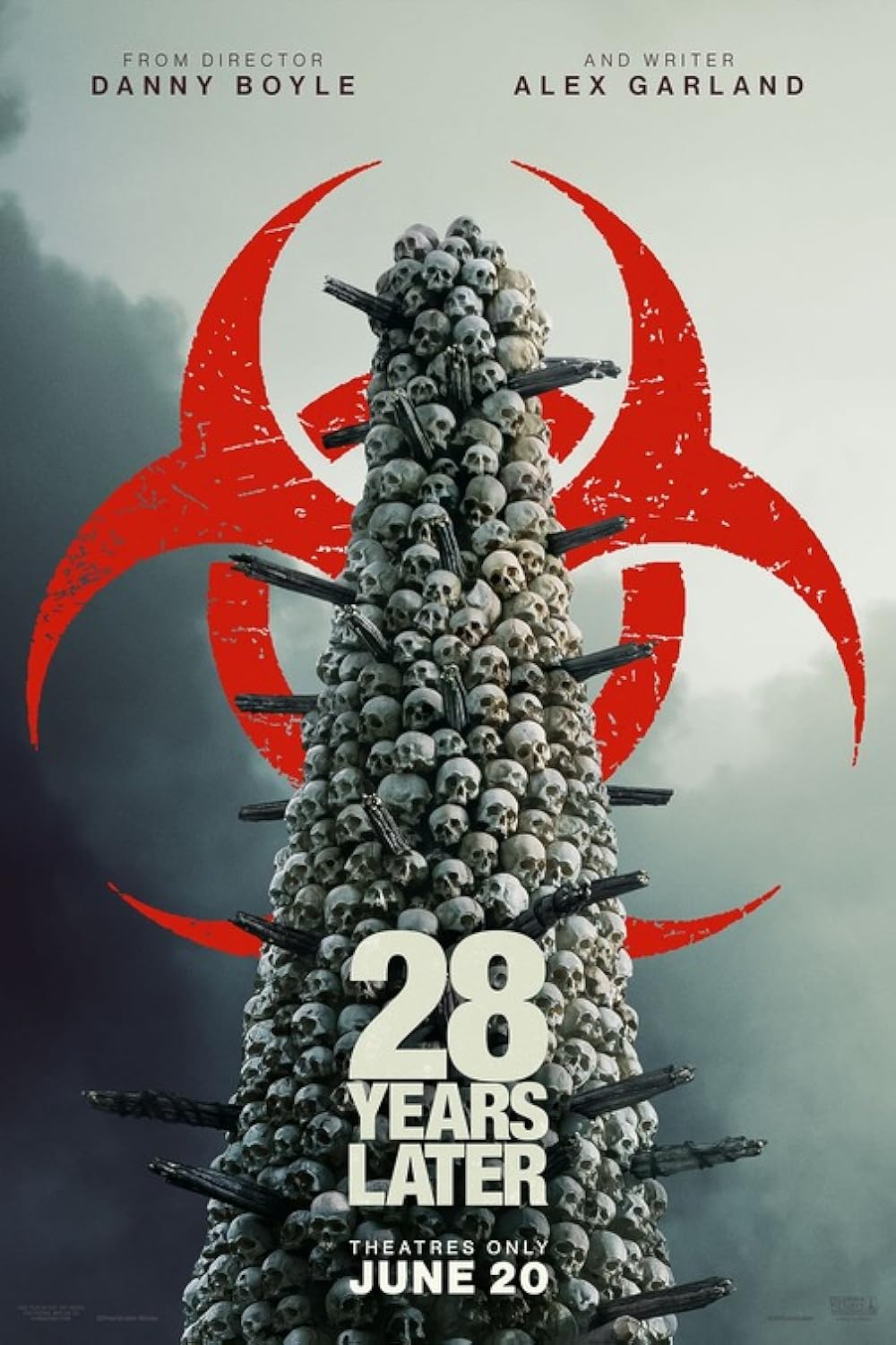
28 Years Later (2025)
Directed by Danny Boyle
Screenplay by Alex Garland
Produced by Bernard Bellew, Danny Boyle, Alex Garland, Andrew Macdonald, Peter Rice
Starring: Aaron Taylor-Johnson, Jodie Comer, Ralph Fiennes, Chi Lewis-Parry, Alfie Williams, Edvin Ryding, Jack O’Connell
Columbia Pictures, Rated R, Running time 115 minutes, Released June 20, 2025

Discover more from Michael J. Cinema
Subscribe to get the latest posts sent to your email.
 Michael J. Cinema
You must be logged in to post a comment.