
On the screen: a green, bucolic, treeless landscape. Welcome to the Scottish isle of Jura. On the soundtrack: the shallow, ragged breath of someone struggling for one more day. These are the dying wheezes of writer George Orwell, born Eric Arthur Blair in 1903. Between those sickly breaths from the sanitarium in Jura, escape some of the most striking words of the 20th century—“War is peace.” “Freedom is slavery.” “Ignorance is strength.” The year is 1950; two years after Orwell published his most famous work, 1984. And here he will die at the age of 46 from tuberculosis.
The story does not end there, but begins. Few authors have outlasted their life like Orwell, and in Raoul Peck’s new documentary, Orwell: 2+2=5, the writer feels as present as his life is past.
Made in cooperation with the Orwell Estate, 2+2=5 is a stirring piece of cinema. Peck mines Orwell’s catalog and diary—particularly the essay, “Why I Write”—and combines them with archival footage, clips from multiple adaptations of 1984, Ralph Steadman’s illustrations of Animal Farm, and contemporary footage of military invasions and devastation to produce a collage that is both a call to action and a work of resignation. You may not leave the documentary feeling hopeful for the future, but for almost two hours, you will not look away, and your attention will not drift.
No easy feat considering the two hurdles Peck’s doc must clear. First, as the current American administration hurtles the country closer to a totalitarian state, the possible artistic reference points from the past are endless. Second, anytime an artist works with an estate, there’s a tendency to shave off the uncomfortable bits in hopes of producing a sanitized text and an approved hagiography.
As to the latter, that’s not the case in 2+2=5. Peck’s documentary is less a celebration of the man and more an exploration of his work. Specifically, the perceptiveness with which he identified the gears of oppression and imperialism. As the narration—provided by Damian Lewis—explains, “In order to hate imperialism, you have got to be a part of it.” Orwell knew what he was talking about. Born in colonial India, the young writer joined the Burmese Indian Police in 1921, only to abruptly quit five years later and announce himself as a writer.
There are other bits of biography Peck uses to inform Orwell’s prose, but, as Peck suggests, this is the moment of clarity from which Orwell the thinker emerges.
As for how 2+2=5 sits within the context of 2025, where movies, new and old, speak of revolution and living under oppression, Peck’s documentary joins the chorus of concern. That means there isn’t much new ground to mine—have Orwell’s books ever not been prescient?—though what conclusions Peck finds does send a chill down your spine. Nineteen Eighty-Four has become the secret playbook for control. That it would be consumed by legions of high school students who would then disregard anything it had to say when they turned on the TV is the bitter pill to swallow.
That was maybe the one thing Orwell didn’t see coming: That consumption would become so rampant, even his books would be consumed with the same voracity as the propaganda he abhorred.
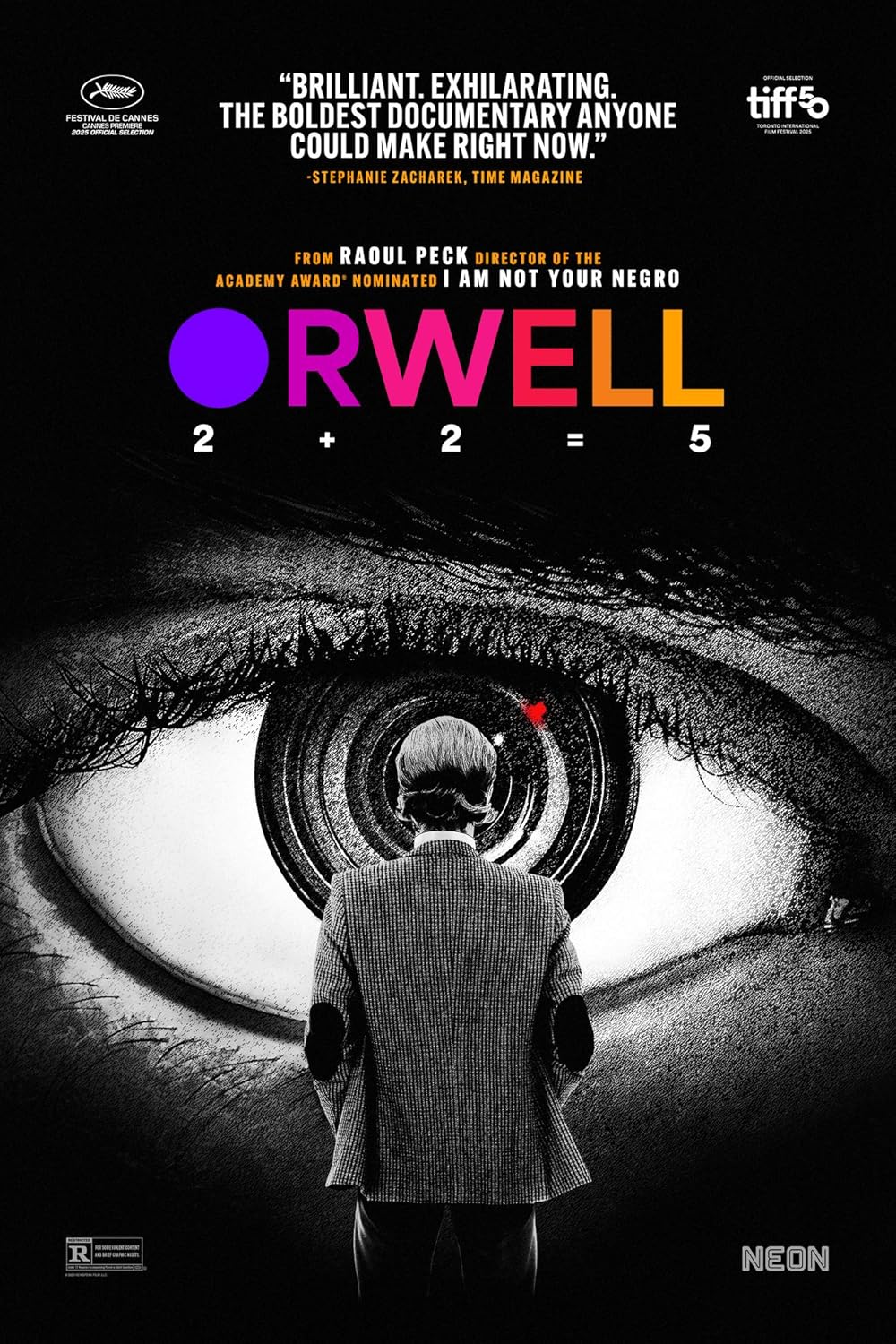
Orwell: 2+2=5 (2025)
Written and directed by Raoul Peck
Produced by George Chignell, Alex Gibney, Raoul Peck, Nick Shumaker
Narrated by Damian Lewis
Neon, Rated R, Running time 119 minutes, Premiered May 17, 2025, at the Cannes Film Festival

Discover more from Michael J. Cinema
Subscribe to get the latest posts sent to your email.
 Michael J. Cinema
One thought on “ORWELL: 2+2=5”
Comments are closed.