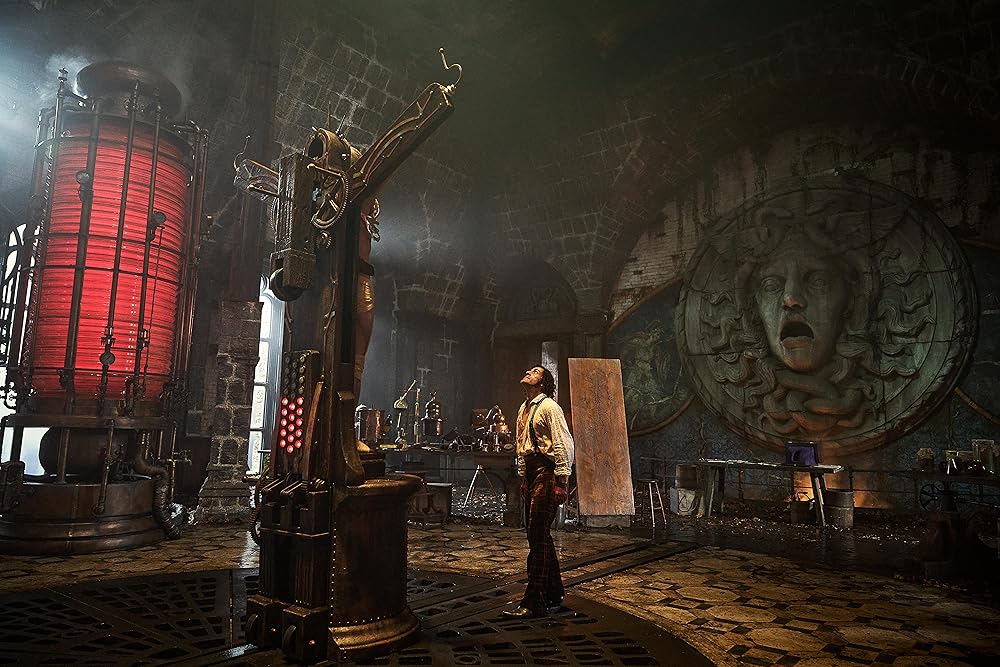
No filmmaker working today makes movies like Guillermo del Toro. His are gothic affairs, full of love and sympathy for all creatures great and small, doomed and saved. The color palettes, even when monochromatically muted, have a garish quality to them. They do not exist in this or any other world, just his.
Curious, then, that del Toro has become preoccupied with others’ stories. With his last three films as director: Nightmare Alley (2021), Pinocchio (2022), and now Frankenstein, del Toro seems more interested in exploring his relationships to core texts than he is with expanding on the worlds of his own creation. And with Frankenstein, del Toro binds Mary Shelley’s 1818 novel, Universal Pictures’ 1931 adaptation and the 1935 sequel, The Bride of Frankenstein, with elements of Frank Darabont’s 1993 script, that one the basis for Kenneth Branagh’s 1994 film. Incidentally, in a 2006 interview, Darabont called that Frankenstein iteration: “The best script I ever wrote and the worst movie I’ve ever seen.”
And from those elements, del Toro shambles through an assembly of familiar set pieces toward an unconvincing grace note. There’s the mad scientist playing god, Victor Frankenstein (Oscar Isaac), the Creature brought to life and gaining self-awareness (Jacob Elordi), an arms dealer with unlimited wealth and a underlying motive (Christoph Waltz), an obsessed sea captain willing to drown all of his men in pursuit of reaching the North Pole (Lars Mikkelsen), and a pack of hunters who head off to the mountains to hunt wolves the moment the wolves show up to feed on the hunters’ sheep. Everyone here is an archetype of a fallen man, furthering the corruption of others. The only good is Elizabeth (Mia Goth), the object of Victor’s lust and the Creature’s need.
Goth is good as Elizabeth—hell, they’re all pretty good, even Elordi, who has to do a lot under some heavy makeup—but it’s not enough to breath life into Frankenstein.
There are moments. Following the wolf attack on the sheep and the return offense at the hands of the men, the Creature observes, “The men did not hate the wolves. The wolves did not hate the sheep. Yet I could sense there was a certain violence to this world.” A moment of clarity that del Toro does not capitalize on. His interests lay elsewhere: a good explosion, lots of special effects, a bit of cringe-inducing gore. Maybe you don’t need hatred to produce violence, but it’s hard to suppress emotions when making motion pictures. And base emotions are the easiest to summon.
Del Toro loves his monsters. He identifies with them in a way that makes you think he either imagines himself as one or wants to be one. A fairly common thought, I’m sure. How many men look in the mirror and wonder what hath god wrought? But del Toro also plays god of this world and a dozen more. He is the one reanimating the past, breathing life into these severed parts. Fitting, then, that in this version of Frankenstein, Victor doesn’t speak the words, “It’s alive!” because very little here feels it.
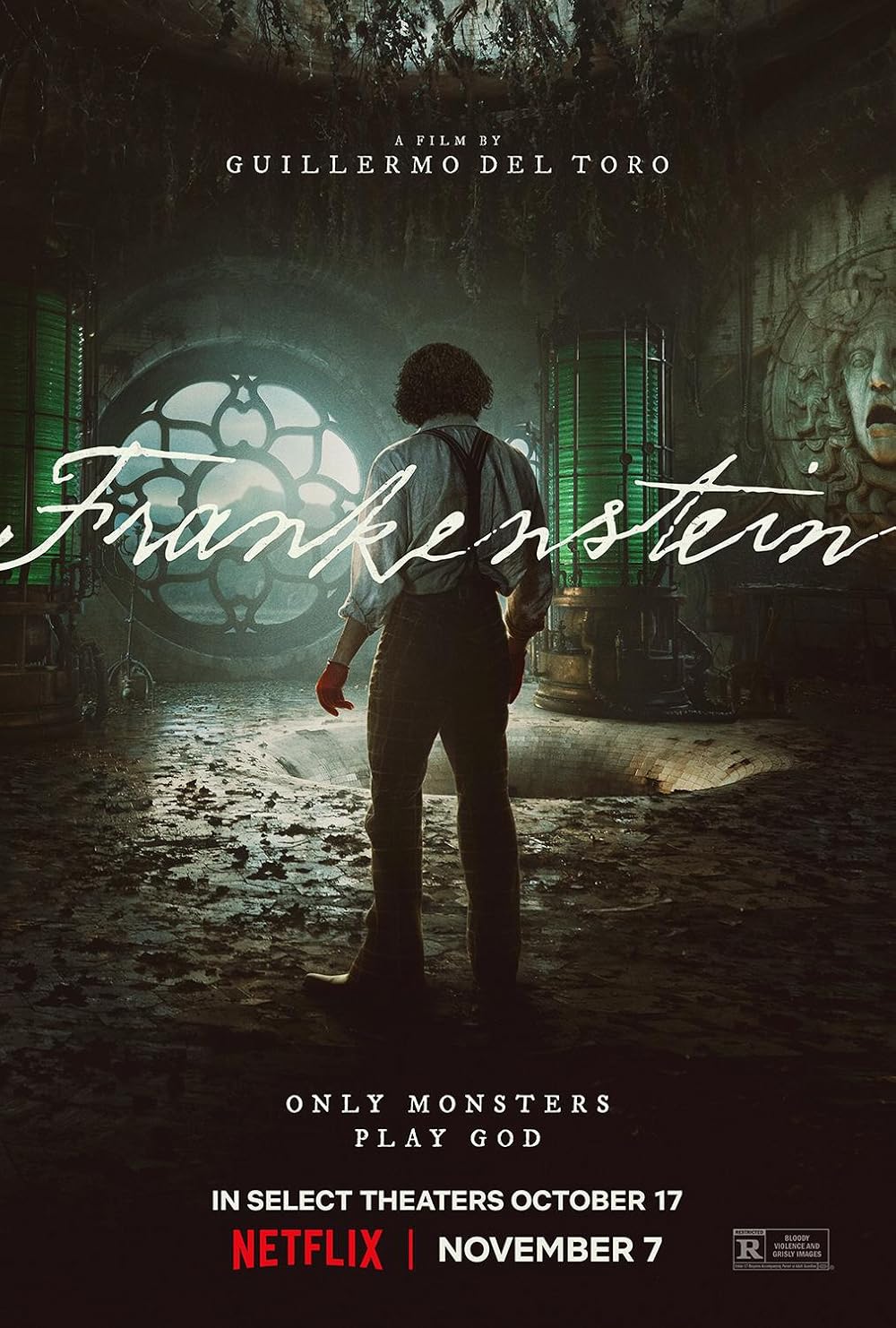
Frankenstein (2025)
Written and directed by Guillermo del Toro
Based on the book, Frankenstein, or: The Modern Prometheus by Mary Shelley
Produced by J. Miles Dale, Guillermo del Toro, Scott Stuber
Starring: Oscar Isaac, Jacob Elordi, Christoph Waltz, Mia Goth, Lars Mikkelsen, David Bradley
Netflix, Rated R, Running time 150 minutes, Premiered Aug. 30, 2025, at the Venice Film Festival

Discover more from Michael J. Cinema
Subscribe to get the latest posts sent to your email.
 Michael J. Cinema
One thought on “FRANKENSTEIN”
Comments are closed.