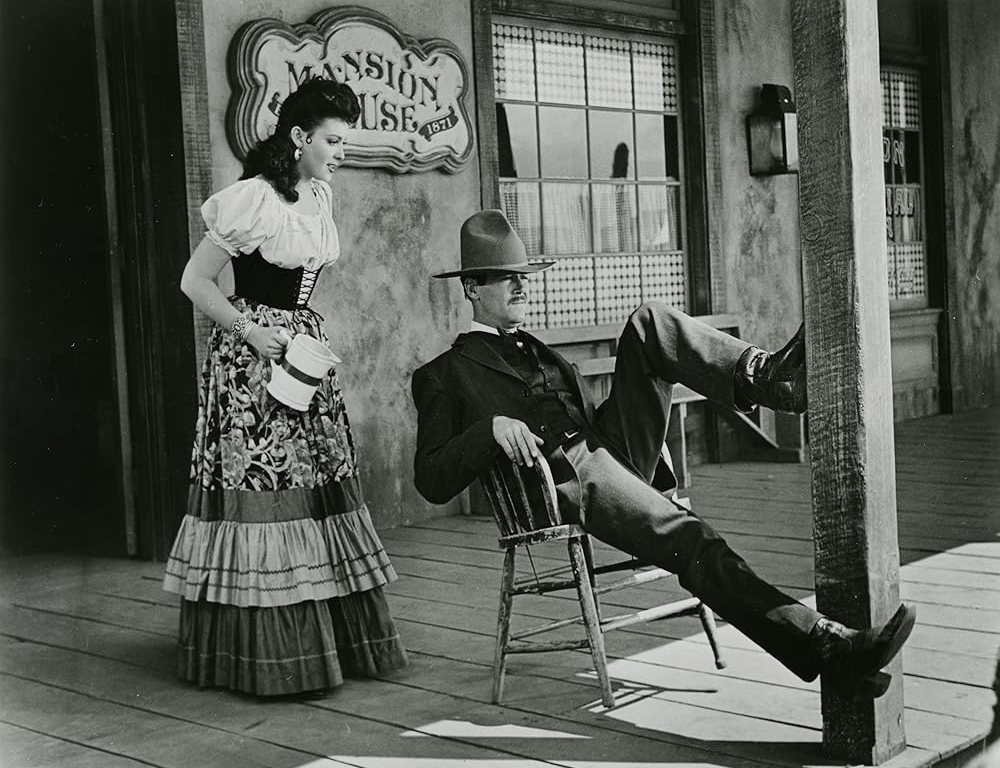
This post is third in a series of movie discussions about westerns at the University of Colorado Boulder’s International Film Series. My Darling Clementine will screen Sunday, Jan. 13, 2026 at 2 p.m. Tickets start at $8.
Though it’s a Western in genre, 1946’s My Darling Clementine is a war movie. It was the first movie director John Ford made following his service in World War II as head of the photographic unit for the Office of Strategic Services—two of his documentaries made at this time, The Battle of Midway (1942) and December 7 (1943), both won Oscars—and continued what Stagecoach started in 1939 by ushering the genre from B-movie relegation into A-level material. Critics called them “psychological Westerns” because they dove beneath the idealized veneer of frontier towns and the white hat black hat dichotomy of good versus evil. These movies are morality tales played out on a historical stage.
And My Darling Clementine is one of Ford’s best. It is a magnificent movie, filled with poetry and conflicting ideals about the need for law and order, and the ease with which it corrupts. The bad guys, the Clanton family led by Newman (Walter Brennan), are so ruthless that not one of them contains a redeeming quality. The good guys, the Earps, led by Wyatt (Henry Fonda), dress in black and wear the badge to avenge personal vendettas. Wyatt even displays tactical subterfuge in the climactic battle at the O.K. Corral. A rousing, heroic movie, My Darling Clementine is not.
What it is is pure myth. Filmed in beautiful chiaroscuro black and white with deep obfuscating shadows, and shot in Monument Valley on the Arizona-Utah border, miles from the real city of Tombstone in southern Arizona, and playing fast and loose with the facts—Doc Holliday (Victor Mature) is a surgeon instead of his real-life occupation of dentist—My Darling Clementine blazes through history with so little care for authenticity it becomes clear that this is a story about something else. It’s about America, sure. But not how America was and is, but how America sees itself. World War II was a just war, and whether or not individuals wanted to go and die for their country, most knew they had to and did. It was a violent, bloody affair wrapped around a holocaust so depraved that we’re still trying to convince people 80 years later of its magnitude. Can one feel elation from a victory that cost so much? Probably not. At least not in Ford’s world. The look on Wyatt’s face at the end of the shootout says it all. No joy. No celebration. Just a silent acknowledgement that the world came to this.
I can only imagine what audiences felt watching My Darling Clementine in 1946. It must have felt like some sort of collective catharsis and resonance, despite the 1882 setting (a bit of mythmaking in its own right, considering the gunfight at the O.K. Corral took place on Oct. 26, 1881). Surely they must have felt the lament of the song that opens and closes the film: lost and gone forever.
And then there is the final shot of the film with Clementine (Cathy Downs) watching as Wyatt and his brother Morgan (Ward Bond) ride off into the distance. It’d been five years since American men started shipping off to war. How many women had watched as those men left, possibly to never return, despite promises they would. Dreadful sorry, Clementine.
With My Darling Clementine, Ford began a theme that would develop and deepen his work into some of the most critical portraits of America figures. These anti-heroes, which Fonda continues as Lt. Col. Thursday—a stand-in for Custer—in Fort Apache (1948) through the 1950s and ’60s with John Wayne in The Searchers (1956) and The Man Who Shot Liberty Valance (1964), fold the myth back on itself until all the joy and promise is wrung out.
That’s what makes these movies so malleable to whatever era audiences discover them. Ford neither explains nor apologizes for his characters and their behavior. A task he leaves to us. The men and women of My Darling Clementine are not echoes of the past but psychological riddles to be solved, ones that may help shape your own feelings about the characters that populate your story. If mythmaking is creating something new, then dissecting and pulling apart that myth is also the creation of something new. And 80 years on, My Darling Clementine still feels new.
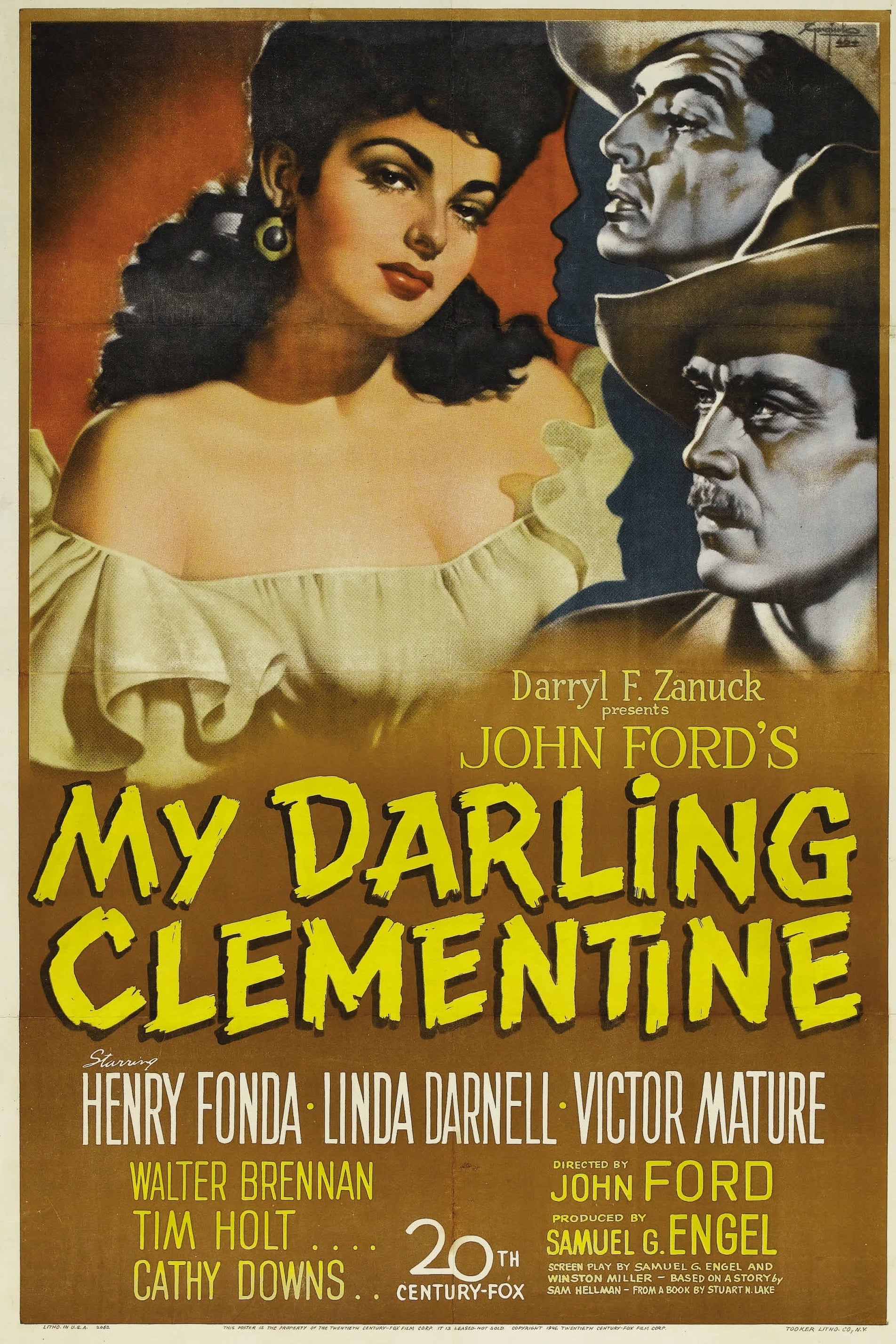
My Darling Clementine (1946)
Directed by John Ford
Screenplay by Samuel G. Engel, Windton Miller
Story by Sam Hellman
Based on the book, Frontier Marshall, by Stuart N. Lake
Produced by Samuel G. Engel
Starring: Henry Fonda, Victor Mature, Linda Darnell, Cathy Downs, Walter Brennan, Tim Holt, Ward Bond, Alan Mowbray, John Ireland, Jane Darwell, J. Farrell MacDonald
20th Century Fox, Not rated, 97 minutes, Premiered Oct. 16, 1946

Discover more from Michael J. Cinema
Subscribe to get the latest posts sent to your email.
 Michael J. Cinema
One thought on “MY DARLING CLEMENTINE”
Comments are closed.