All movies, at some point, contain a test. A moment in the narrative where you, the viewer, get to decide to continue down the path the movie walks, or go and find something else to watch. Some movies are more upfront about it than others. 28 Years Later: The Bone Temple is that movie.
The test comes immediately: Two children forced to fight to the death with knives. If you’ve been following along with the 28 Days Later franchise, then you know why this movie inhabits a world where a couple of tweens would be in such a situation. If you aren’t, then what a bizarre entry point this movie must be.
Anyway, two kids enter, one kid exits. And when the loser suffers the fatal blow, a strike to the femoral artery that gushes a river of blood, the vanquished has no idea he has 30 seconds left to draw breath and wastes a good 10 of them laughing at the blood. Then he grows concerned, pleads, cries, and dies. His skin turns a pale white; he breathes no more. The victor takes his place in the cult, which leaves the body and moves out into the world—a world infected by the rage virus that turns ordinary humans into violent, consuming monsters.
Director Nia DaCosta, working from a screenplay by Alex Garland, presents this moment so flat, so without adornment, that I damn near passed out—something I haven’t done since my days as a church-going child. That’s the test you have to pass when entering The Bone Temple. As one friend put it, after that moment, he was never so happy to merely see someone get bitten by a zombie.
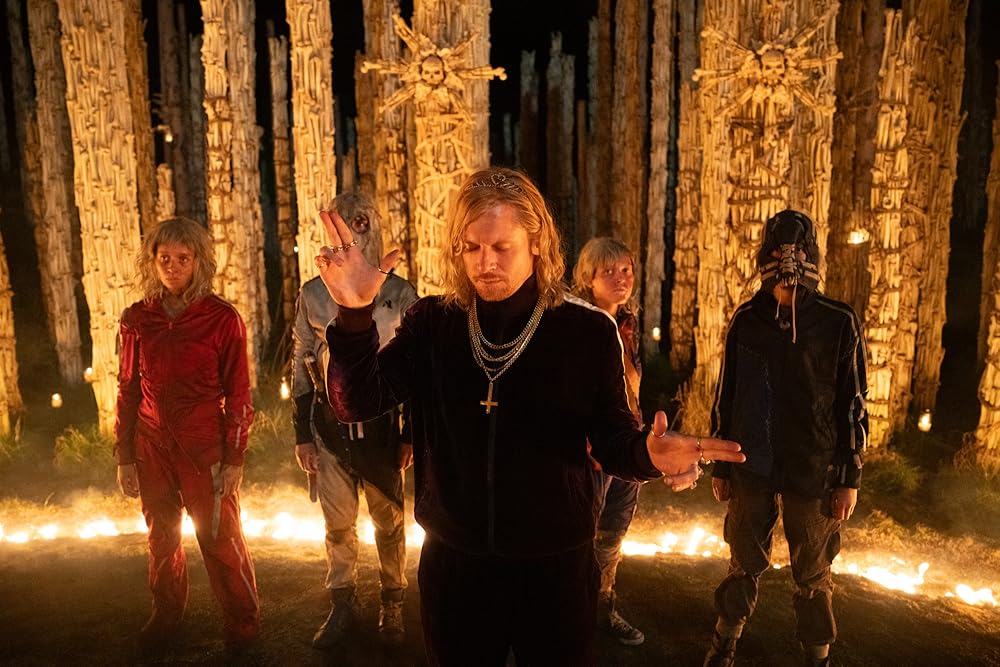
From there, it gets better. Sort of. The Bone Temple, another middle chapter in the franchise, depicts a world possibly emerging from cruelty. True, the rage virus still has a grip on the British Isles, and Spike (Alfie Williams) is now an inducted member of the Jimmys, led by Sir Jimmy Crystal (Jack O’Connell), a tracksuit-wearing, Teletubbies-loving, son of a vicar with an awful lot of hate in his heart and an affection for blond wigs. Sir Jimmy was old enough to form memories of the world before the rage virus, but his child followers, whom he calls “Jimmy” or “Jimmima” and refers to as the fingers that make up his fist, were not. That allows Sir Jimmy to pervert pop culture and sacred texts into a mythology that makes him ripe for cult leadership. Some of the kids buy the snake oil. Some of them know buying it is the only way to survive.
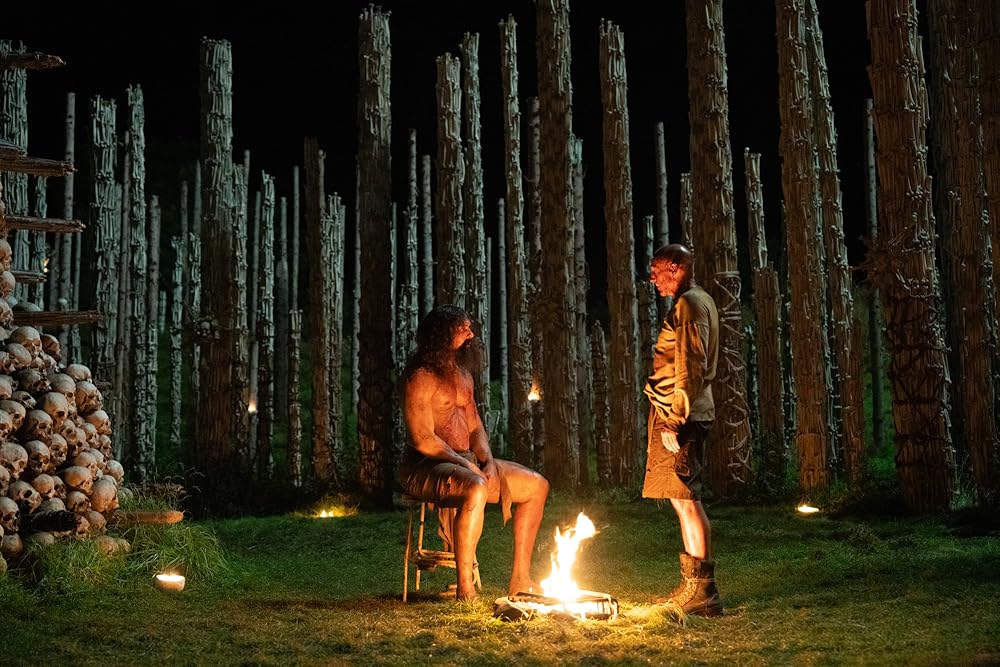
Not far away, Dr. Kelson (Ralph Fiennes) continues his memento mori work of burning the deceased and displaying their scrubbed skeletons in a massive monument, the titular bone temple. He also strikes up a friendship, of sorts, with an alpha zombie, the hulking and naked Samson (Chi Lewis-Parry). Their relationship leads Kelson to discover that the rage virus isn’t just physical; it’s psychological. Samson isn’t a mindless zombie—his mind has betrayed him and manipulated him into something he wouldn’t choose to be if given the choice.
This revelation, shown in quick bursts from the infected’s point of view, complicates the usual zombie mythos. In the previous 28 movies, as well as other zombie movies, zombies are not thinking, creating, individuals. They are mindless hoards hell bent on feasting. They can stand in for anything, metaphorically speaking, and can be killed without remorse from either the characters within the narrative or those watching from the comfort of a movie theater. But in The Bone Temple, there might be a way to shake the disease and return individuality and humanity to the sick. Curious. Would a scene with an infected bleeding out, only to realize a second too late that these are their last moments, have an effect like the child dying in Bone Temple’s opening?
Yet, despite all that physical and ideological provocation, I find these movies to be simplistic and a little silly. When Sir Jimmy encounters Kelson, the two hatch a plot full of theatrics that is both amusing and ridiculous. Even the kids seem reticent to buy in—in the way that most kids treat adults with an air of healthy suspicion. And when Kelson tries to turn the tables on Sir Jimmy, he does so with an equally theatrical charge. Fascinating that while the world around them is driven by one thing and one thing only, consumption, both pause for mythmaking. That turns out to be a costly foible by two men who survived up to this point by dispensing with such frivolity.
From there, DaCosta and Garland craft another cliffhanger ending that sells the next movie while presenting the core question of the series: Is the desired outcome a return to the world as it was, or the creation of something new? Sir Jimmy represents the world as it was, but so does Kelson. Yet the world gets smaller and smaller by the day. Will all this culling get us somewhere, or is history and humanity forever locked in a cycle of death and destruction? We still have at least one chapter left in this story, so all might yet be revealed. But one thing is certain: These movies are long on questions but short on answers.
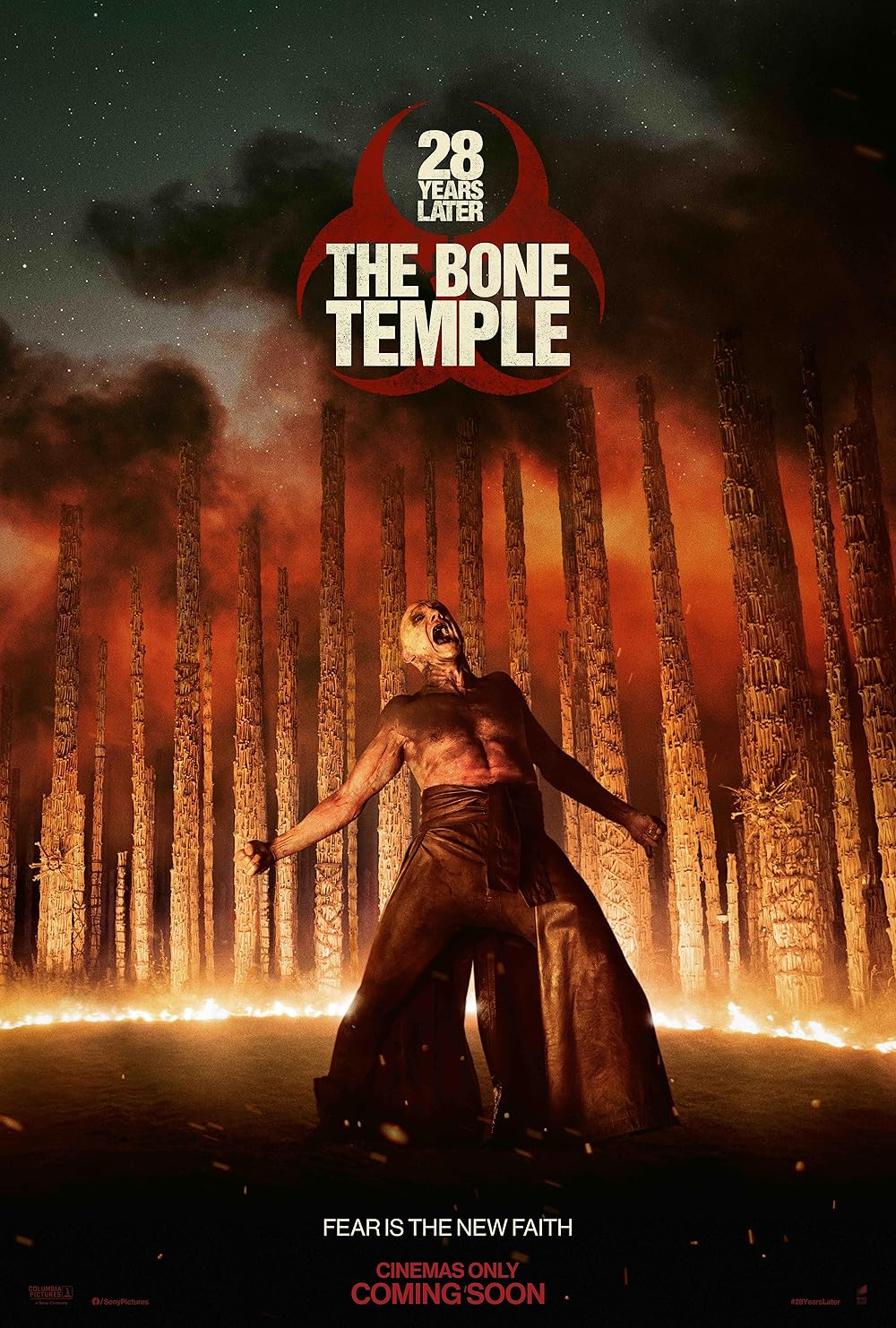
28 Years Later: The Bone Temple (2026)
Directed by Nia DaCosta
Screenplay by Alex Garland
Produced by Bernard Bellew, Danny Boyle, Alex Garland, Andrew Macdonald, Peter Rice
Starring: Ralph Fiennes, Alfie Williams, Jack O’Connell, Chi Lewis-Parry, Emma Laird, Connor Newall, Erin Kellyman, Maura Bird, Ghazi Al Ruffai, Robert Rhodes, Sam Locke
Columbia Pictures, Rated R, Running time 109 minutes, Opens Jan. 16, 2026

Discover more from Michael J. Cinema
Subscribe to get the latest posts sent to your email.
 Michael J. Cinema
One thought on “28 YEARS LATER: THE BONE TEMPLE”
Comments are closed.