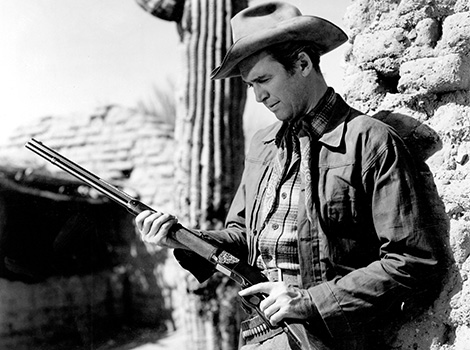
When it comes to westerns, 1950 was a banner year.
More than 125 features were released that year—a high-water mark the genre would never again see—and many would become emblematic of the genre: John Ford’s Wagon Master, Henry King’s The Gunfighter, Delmer Daves’ Broken Arrow, etc., etc. That last one, Broken Arrow, starring James Stewart, is notable as one of the first Hollywood western to treat Native Americans sympathetically. So, too, did Devil’s Doorway, which Anthony Mann directed.
Mann had a hell of a 1950. In addition to Devil’s Doorway, he directed Walter Houston in his last movie, The Furies, co-starring the great Barbara Stanwyck, and began a fruitful collaboration with Stewart in Winchester ’73. And of all the movies Mann and Stewart made together, and of all the westerns released in 1950, and of all the westerns made at home and abroad, Winchester ’73 might be the best.
Granted, no one really thought that would be the case. As the story goes, Stewart wanted to reprise his role of Elwood P. Down in the screen adaptation of the play Harvey (also a 1950 release), but Universal Pictures, who owned the screen rights to the play, couldn’t afford Stewart’s salary. So Stewart’s agent—Lew Wasserman, who would end up running Universal Pictures the following decade—negotiated a deal where Stewart would take less salary up front in favor of a percentage of the box office. Commonplace today, the practice was unheard of back then. So, to sweeten the deal, Stewart would also star in Universal Picture’s Winchester ’73, a western that had just dropped Fritz Lang and picked up Mann as director.
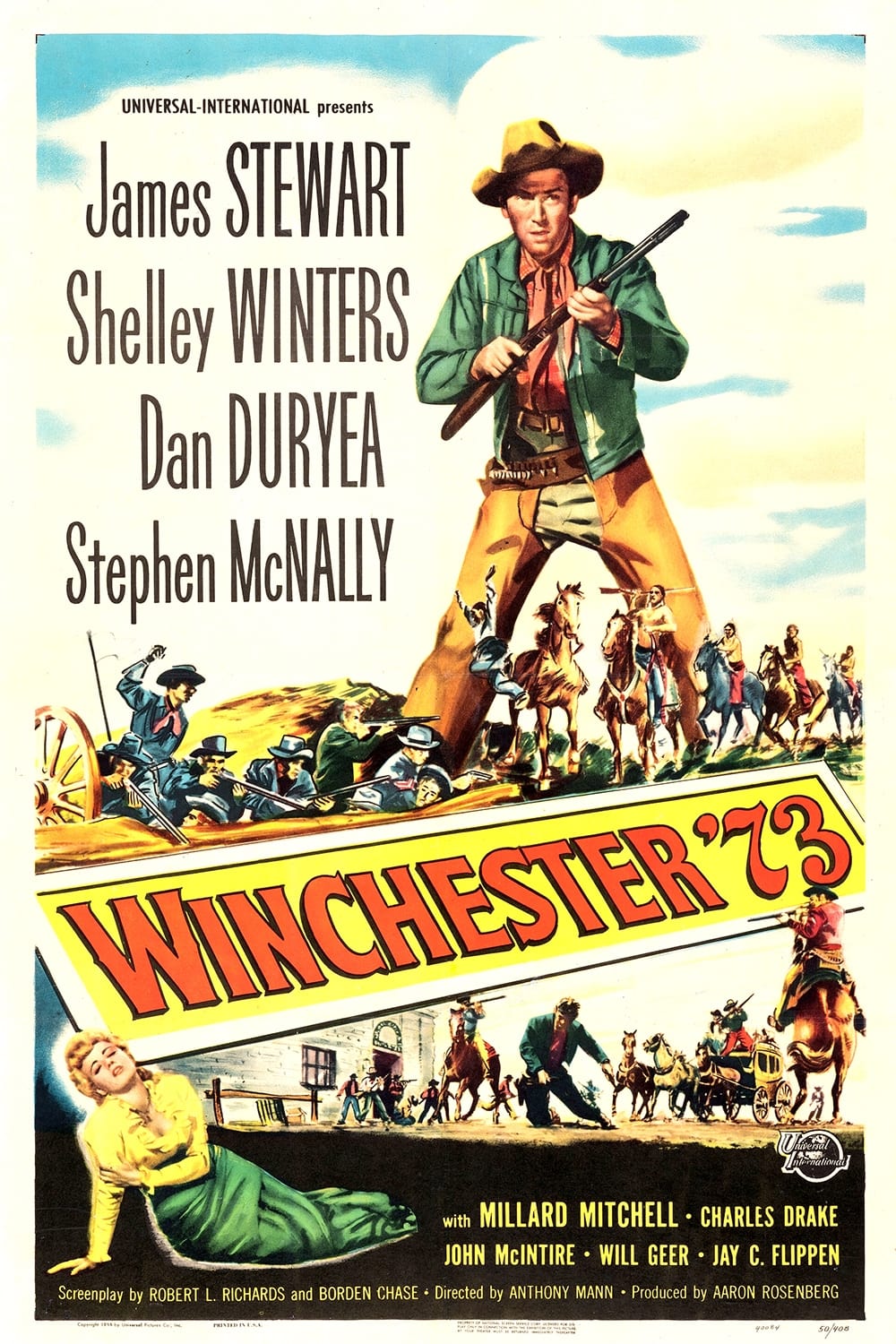
Prior to 1950, Mann’s domain in Hollywood was low- to mid-budget noirs—tough, violent pictures that spared no one, least of all the hero. By carrying that punch to the frontier of the 19th century, Mann charged the genre and Stewart’s career in a way that’s still shocking.
Winchester ’73 is a dark exploration of obsession and possession. A Biblical story of two men, one out for profit (Stephen McNally), the other out for revenge (Stewart), backed an assembly of outstanding supporting characters: Shelley Winters, Dan Duryea, Millard Mitchell, John McIntire, and Jay C. Flippen. Only two stick out like sore thumbs and date the proceedings: Rock Hudson appears in redface as Young Bull, a common practice at the time that has aged poorly, to say the least, and Tony Curtis as a young Calvary soldier. Curtis was always beautiful, but next to the grizzled and dusty Flippen or Stewart and his sweat-stained hat, Curtis looked like he wandered in from an adjacent set.
Winchester ’73 plays the Wild West motif like a myth. The story opens in Dodge City on July 4, 1876. To mark the United State’s centenary, the Winchester rifle company sent a ’73 model as the prize of a shooting contest. The rifle is said to be perfect in production, and young boys and grown men ogle it. Marshal Wyatt Earp (Will Greer) would give up his salary to own it, but the gun is not for sale. It can only be won, which is why Lin McAdams (Stewart) and war buddy Frankie “High Spade” Wilson (Mitchell) are here. They are hunting “Dutch” Henry Brown (McNally), though they don’t know him as Dutch, and Lin suspects Dutch to be in Dodge City after the Winchester.
He’s correct. And Earp is correct when he says the Winchester cannot be purchased. The rifle is a cursed talisman and woe to those who acquire it through nefarious means. Which many do, and they all die. Only those who are worthy of it are safe. It’s an American Excalibur.
And though Lin hunting Dutch forms the arc of the narrative, Borden Chase’s screenplay follows the rifle as it passes from hand to hand. This gives Winchester ’73 an episodic quality that doesn’t often work well in other movies but comes off like a dream here. Hell, in another world, Winchester could have played on the small screen as a successful TV show that would have followed the rifle from every legendary figure of the West, with each episode ending with Lin still hot on Dutch’s heels.
But at a taught 92 minutes, Winchester ’73 zips along—a movie that feels so much fuller than its runtime betrays.

A lot of that is due to Chase’s streamlined screenplay that relies on historical shorthand and Mann’s economic visual storytelling. But even more might be due to Stewart and Mann’s collaboration. Stewart, the iconic boy-next-door of the aw-shucks variety of the 1930s and early ’40s, had gone to war and came back a changed man. He wanted something different, something darker. Mann, bringing the stain of the streets with him, gave Stewart exactly what he needed. And Stewart is terrifying when he hammerlocks Duryea’s shooting arm and slams him against the bar. The look in his eyes at that moment is not something audiences would have expected in 1950 but would become more familiar with as the decade closed. Even today, that moment in the bar erupts with such violence that it still takes you off guard.
Stewart would continue to plum the darkness in four more westerns with Mann: The Bend of the River (1952), The Naked Spur (1953), The Far Country (1954), and The Man from Laramie (1955). In all, Stewart rode the same horse, Pie, and wore the same hat. All are good, but Winchester ’73 is great. There’s a lighting-in-a-bottle quality to it that still crackles 75 years on. It’s one of those movies that, if you had to show someone one western to either introduce or encapsulate the genre as a whole, Winchester ’73 might be it.
Available on home video from The Criterion Collection, the Winchester ’73 set features a beautiful 4K digital restoration undertaken by Universal Pictures in collaboration with The Film Foundations—reason enough to spring for the 4K UHD disc. The commentary track, recorded in 1989, features film historian Paul Lindenschmidt and a relatively sharp Stewart reflecting on the movie. The 30-minute documentary, Force of Nature: Anthony Mann at Universal, is a good primer on the director, the interview with film programmer Adam Piron provides valuable insight on the portrayal of Native Americans in westerns, and Imogen Sara Smith’s booklet essay digs into the heart of what makes Winchester ’73 a true classic.
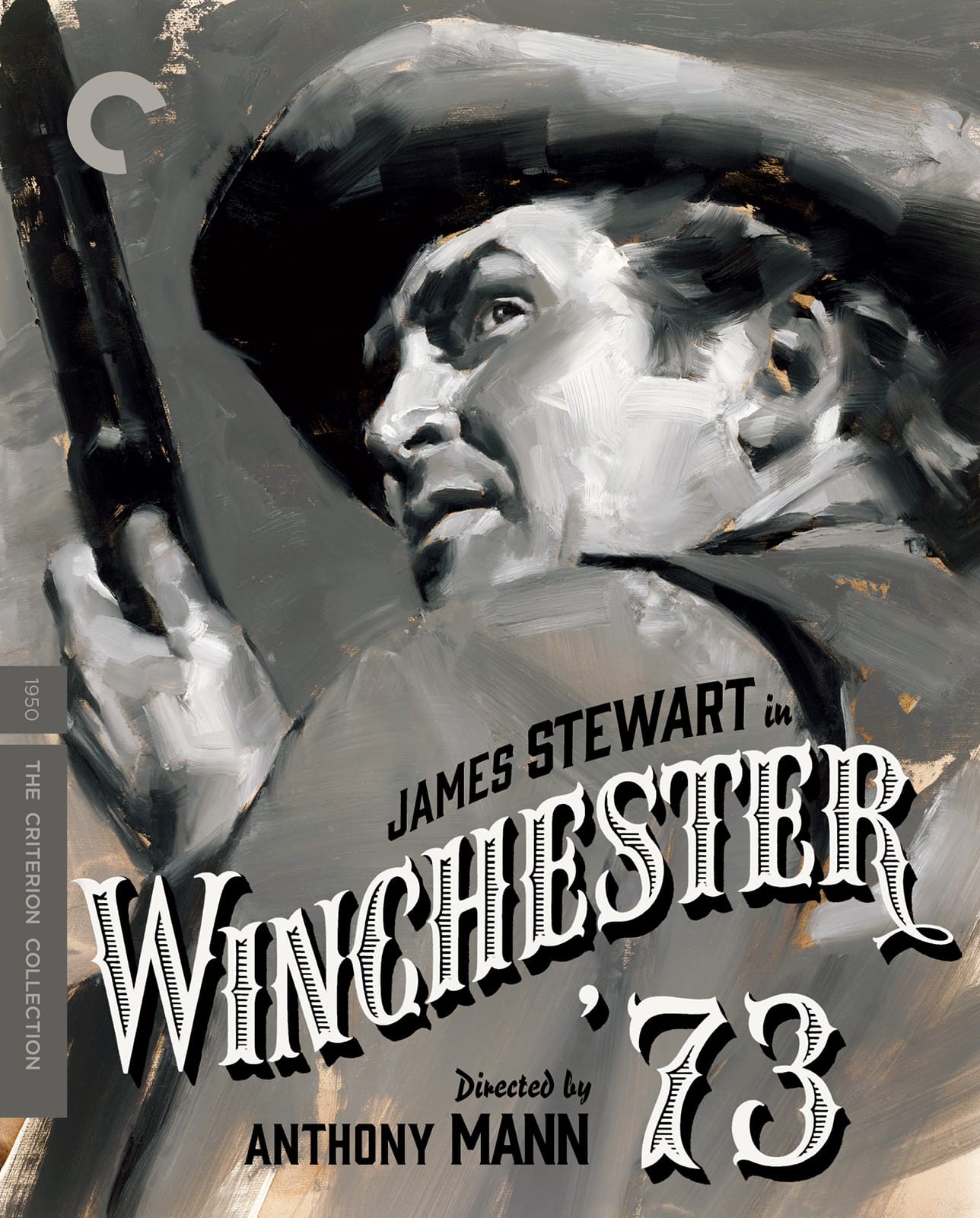
Winchester ’73 (1950)
Directed by Anthony Mann
Screenplay by Borden Chase, Robert L. Richards
Based on a story by Stuart N. Lake
Produced by Aaron Rosenberg
Starring: James Stewart, Shelley Winters, Dan Duryea, Stephen McNally, Millard Mitchell, John McIntire, Will Geer, Jay C. Flippen, Rock Hudson, Tony Curtis
Universal Pictures, Not rated, Running time 92 minutes, Premiered June 1, 1950
Discover more from Michael J. Cinema
Subscribe to get the latest posts sent to your email.
 Michael J. Cinema
You must be logged in to post a comment.