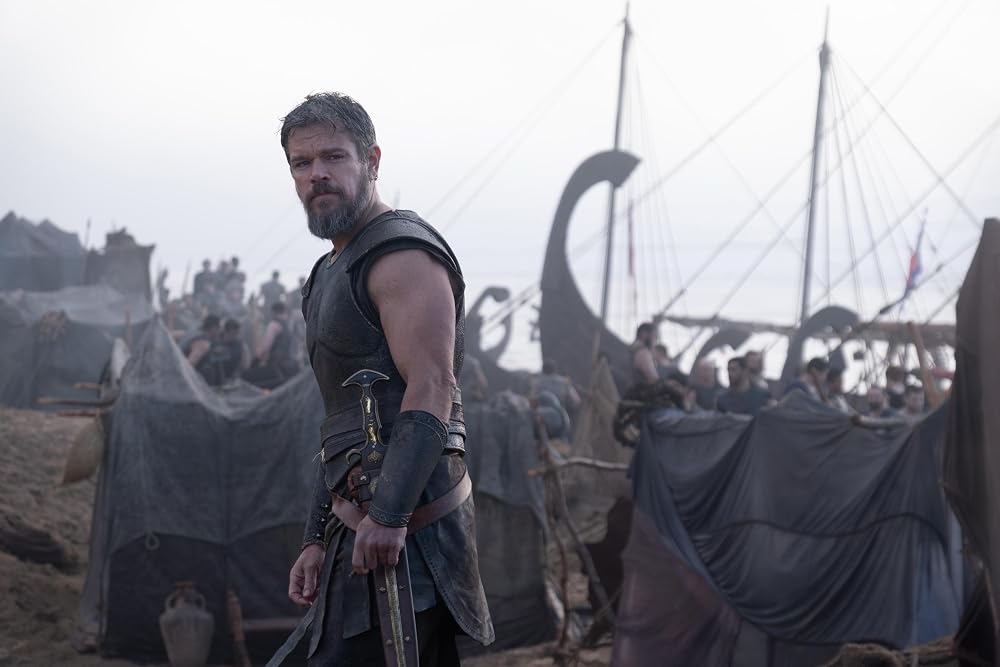
It was Odysseus’ cleverness that separated him from mortal men. And it was cleverness that did wise Odysseus in. True, only he could have devised the plot to enter Troy’s impenetrable gates. But little did he, or anyone else, know that cleverness would consign him and many more to an exile that would last years, possibly even generations.
For filmmaker Christopher Nolan, the story of The Odyssey is the story of the fall. Here, the Bronze Age plays garden, and Zeus’ Law stands in for the apple. Makes sense: It was an apple—a golden apple, to be specific—that poor Paris used to set all that followed in motion. A thousand ships launched, thousands of men perished on the beaches of Troy, and a city fell. For Odysseus to atone, exile was the only option.
The Odyssey, the latest from Nolan, is an ambitious, largely humorless, three-hour pop spectacular filmed entirely with IMAX cameras that pillages the past in hopes of understanding the present. Matt Damon plays the lost war hero Odysseus, Tom Holland his beleaguered son Telemachus, and Anne Hathaway as his faithful Penelope, forever weaving and unweaving her father-in-law’s burial shroud to stave off the suitors knocking at the door.
If you’ve never read The Odyssey or seen its multiple cinematic adaptations, fear not. Nolan’s version makes plenty of space for explanation of Odysseus’ long and winding road, not to mention the plethora of characters populating these islands and seas. For those familiar with Homer’s epic poem, there’s plenty here to instill a sense of awe, from fantastic beasts to wandering trees—a good deal of them depicted with practical effects. They give The Odyssey a tactility worthy of the narrative’s grandeur. Odysseus’ ship scraping against the waves, oars snapping against rocks, a giant wooden horse dragged across sand and logs. All bring life to this world, all underline one simple fact: Danger is everywhere.
Yet, there is something missing from Nolan’s Odyssey. The gods, though invoked in dialogue, are absent, save for Athena (Zendaya), an apparition only Odysseus can see. Polyphemus, the great Cyclops, is rendered mute, and Poseidon’s punishment must be read between the lines.
They are not the only detractions. As in his other films, Nolan likes his scores wall-to-wall and louder than hell. Ludwig Göransson draws the assignment—he previously worked with Nolan on Tenet—and delivers what the two hope immersion sounds like. The results are closer to submission, which distract more than they add. Take the climactic moment where Odysseus strings his bow and plucks the string. The sound should send shivers down men’s spines. But since Göransson’s score already has a stringed instrument plucking away, the pronouncement is undercut.
Regardless of its faults, The Odyssey is a tremendous movie. I don’t love it, but I am impressed. The actors, particularly John Leguizamo as the swine herder Eumaeus, and Robert Pattinson as lead suitor Antinous, are excellent. Ditto for how Nolan unpacks Homer’s epic narrative into a propulsive three-hour film. It’s somewhat ironic that a story about a man lost at sea who can’t find his way home is rendered into a movie that plays like a train steaming into the station.
Maybe that’s because Nolan’s Odyssey is more war film than adventure film. He’s more interested in Odysseus the traumatized than he is Odysseus the wanderer, and fractures the narratives through flashbacks, absences, and misremembered moments. And despite all the gods and monsters available to him in Homer’s poem, Nolan remains intoxicated with the thrill of combat, the redemption through slaughter, the heroic baptism of blood.
There’s a way to do both. After what Odysseus witnesses in waves and war, normal life would have been impossible. So he must wander, he must heal, he must find within himself a new man, a new humility, before he can wash up on Ithaca’s shore—the same shore a much different man left 20 years before. That’s the journey that makes The Odyssey the urtext that echoes across time and space.
So we sing the song of Odysseus again, this time with massive images, thrumming music, and a star-studded cast. Nolan’s interpretations breathe new life into familiar moments in hopes of shedding light on the specific when maybe the eternal would have suited his aims better. After all, The Odyssey isn’t going anywhere. As Llewyn Davis once said in the middle of his own odyssey, “If it was never new, and it never gets old, then it’s a folk song.”
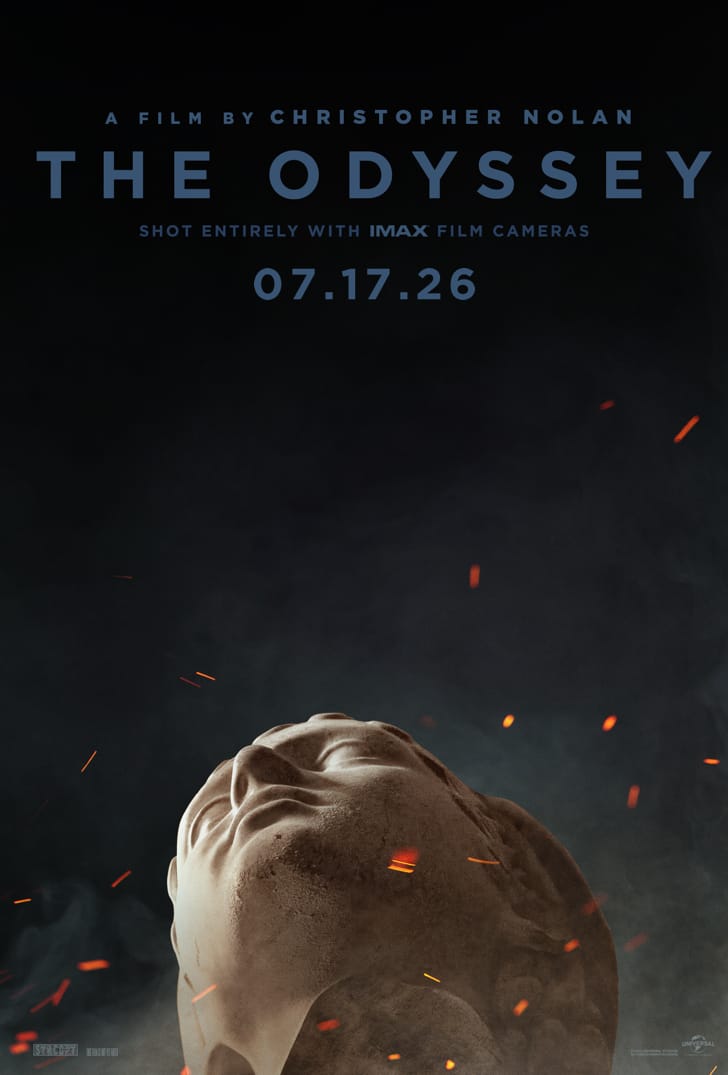
The Odyssey (2026)
Written for the screen and directed by Christopher Nolan
Based on the epic poem by Homer
Produced by Christopher Nolan, Emma Thomas
Starring: Matt Damon, Tom Holland, Anne Hathaway, Robert Pattinson, Zendaya, John Leguizamo, Himesh Patel, Jon Bernthal, Elliot Page, Lupita Nyong’o, Charlize Theron, Samantha Morton, Mia Goth
Universal Pictures, Rated R, Running time 172 minutes, Opens July 16, 2026

Discover more from Michael J. Cinema
Subscribe to get the latest posts sent to your email.


One thought on “THE ODYSSEY”
Comments are closed.